

Key takeaways
- Compare the best chair mats for hard floors, from rigid clear mats to polycarbonate and woven styles that protect wood, tile, and laminate floors.
Rolling chair casters are quietly destructive on hard floors. Each caster concentrates your weight on a small contact patch, and months of rolling grinds fine scratches into hardwood, dulls laminate, and can crack brittle tile grout lines. A chair mat spreads that load and gives the casters a sacrificial surface to roll on instead. Mats for hard floors differ from carpet mats in one essential way: the underside must be completely smooth, because the studs and cleats that grip carpet will scratch and dent a hard surface. Beyond that, the category splits by material and stiffness, from rigid clear panels to flexible vinyl and woven-look mats. This guide compares five hard floor mats across those styles.
As an Amazon Associate, we earn from qualifying purchases.
Quick answer
For most desks, the MuArts rigid clear mat is the strongest all-round pick, with a thick, flat surface that casters glide on without denting. The Floortex polycarbonate mat is the premium long-life option, the Kuyal is the flexible budget mat, the Jonov covers extra-large rolling areas, and the RccugmatS woven-look mat suits rooms where a plastic panel looks out of place.
MuArts Crystal Clear Heavy Duty Chair Mat, 47 x 35 Inch

The MuArts mat is built like a panel rather than a sheet: about a fifth of an inch thick, rigid, and shipped flat, so it lies completely flat from the moment it is unboxed, with no curled edges to flatten out over days. That rigidity is the point. Thin flexible mats develop dips under the casters, and rolling in and out of a dip all day is what makes a chair feel heavy; a rigid surface keeps rolling effortless and spreads the load so the floor beneath never sees a concentrated pressure point. The crystal clear finish lets the floor show through almost undisturbed, which matters on good hardwood you did not buy to hide. At 47 by 35 inches it covers the standard rolling zone under a desk, the area a chair actually travels when you sit, turn, and push back. The maker positions it for hard floors and low carpet alike, but its smooth underside and rigid glide surface are squarely in hard floor territory. It cannot be rolled or folded for storage, so plan its spot once. For a permanent desk on wood, laminate, or tile, this is the mat that behaves most like part of the floor.
Floortex Cleartex Ultimat Polycarbonate Chair Mat for Hard Floors, 47 x 35 Inch
Floortex builds its Cleartex Ultimat line from polycarbonate, the material class used where impact strength really matters, and the maker rates it at roughly double the impact strength of PVC vinyl. In chair mat terms that translates to a mat that will not crack under a dropped chair base, will not curl at the edges, and will not yellow or develop the odor that older vinyl mats can give off. The mat is thinner than the MuArts at well under a tenth of an inch, yet stays perfectly flat and rigid enough for an easy glide, which makes it the easier of the two to slide under an existing desk setup. The rectangular 47 by 35 inch shape, model FC128919ER, has straight corners and a smooth back made specifically for hard floors, with no gripper teeth. Polycarbonate is the premium material in this category and the price follows, but it is also the buy-once option: offices standardize on these because they survive years of daily rolling without the surface going cloudy or the edges lifting. Choose the Floortex if the desk is a long-term installation and you want the mat decision finished for the foreseeable future.
Kuyal Clear Chair Mat for Hard Floors, 36 x 48 Inch
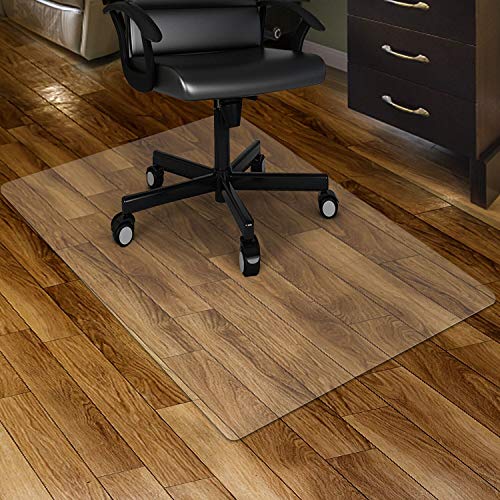
The Kuyal mat is the straightforward flexible PVC option, and it covers the basics properly. It is designed for hard floors only, with a smooth underside treated with an anti-slide coating that keeps the mat in place on wood, tile, laminate, vinyl, stone, and concrete without any studs or cleats touching the surface. The rectangular 36 by 48 inch footprint, model KY-013, gives a little more front-to-back coverage than the 47 by 35 mats, useful when the desk is deep or the chair rolls back a long way. Being flexible PVC, it can be rolled for moving or storage, which the rigid panels cannot, and it arrives at a friendlier price point than polycarbonate. The trade-offs are the familiar vinyl ones: it is thinner, so heavy users may feel more give under the casters, and it needs a day or so unrolled, ideally weighted at the corners, before it lies fully flat. None of that prevents it from doing the core job, stopping caster wear on the floor, perfectly well. For a first home office, a rental where the desk may move, or a lighter user, the Kuyal is the sensible spend.
Jonov Office Chair Mat for Hardwood Floor, 63 x 51 Inch

Most chair mats assume a small rolling zone, and most chairs do not stay in one. The Jonov mat is cut for people whose chair travels: 63 by 51 inches, substantially larger than the standard mats here, covering the full arc from desk front to the push-back position, plus side movement for L-shaped desks and gaming setups where the chair swivels between screens. The clear finish keeps a big mat from visually swallowing the room, and the anti-slip underside is specified for hard floors, with an easy-glide top surface for casters. A mat this size also protects the floor from more than casters: dropped items, shoe heels at the desk edge, and the slow traffic wear of a busy workstation. The cautions are practical. Measure the space before ordering, because 63 inches of width will not fit between every desk leg arrangement, and a large flexible mat takes longer to settle flat than a small one. It is also more mat than a compact desk needs. But if your current mat’s edges are exactly where your casters keep escaping onto bare floor, the fix is not a thicker mat, it is a bigger one, and this is the bigger one.
RccugmatS Chair Mat for Hardwood and Tile Floor, 36 x 48 Inch, Gray

Every other mat in this guide is clear plastic, and in a living room or a finished bedroom office, a clear plastic panel is not always welcome. The RccugmatS mat takes the woven route: a fine woven surface that reads as a low-profile rug rather than a sheet of plastic, in a gray finish that sits naturally under a desk in a furnished room. Underneath, it is a hard floor mat in the proper sense, with an anti-slip backing, a surface that will not curl at the edges, and a build aimed at hardwood and tile. At 36 by 48 inches it matches the standard rolling zone. Woven surfaces roll slightly less freely than polished rigid plastic, the casters meet a little more resistance, which some users actually prefer because the chair stays where it is parked instead of drifting. The fabric-style top also hides dust, crumbs, and scuffs that a crystal clear mat displays in high definition, so it asks for less cleaning to look tidy. The trade-off is that spills need a wipe rather than a rinse, and the look is a deliberate gray, not invisible. For desks in shared living spaces, that trade is usually worth making.
How to choose
Confirm the underside first: a hard floor mat must be smooth underneath, with no studs, cleats, or gripper teeth, which belong on carpet mats and will mark wood and laminate. Next, pick the material by how permanent the desk is. Rigid panels and polycarbonate lie flat immediately, roll best, and last longest; flexible PVC costs less and stores rolled, but needs time to flatten and gives a little under heavy casters. Size is the third decision, and the most commonly botched. Sit in your chair and note how far it actually rolls in each direction, then buy a mat that covers that whole zone with a few inches to spare; a mat that is too small just relocates the wear to its edges. Thickness works differently than people expect: on hard floors, stiffness matters more than thickness, because a stiff thin mat out-rolls a soft thick one. Finally, consider the room. Clear mats disappear on attractive floors, while woven and colored mats look intentional in living spaces where a plastic sheet would stand out.
Who should skip
Skip chair mats if your chair has no casters, since a fixed chair does no rolling damage and a mat only adds a tripping edge. Skip the flexible vinyl mats if you are a heavy user on a chair that rolls all day; the rigid and polycarbonate mats will serve you longer. Skip oversized mats for small rooms where the mat would run under other furniture, because trapped edges lift and curl. And skip hard floor mats entirely if your desk sits on carpet, even low pile: a smooth-backed mat will skate on carpet, and the studded carpet version is the correct tool. Never use a carpet mat on a hard floor as a stopgap, because its cleats can scratch the surface you are trying to protect.
Frequently asked questions
Will a chair mat damage hardwood floors?
A proper hard floor mat protects hardwood rather than damaging it, provided the underside is smooth and the floor is clean when the mat goes down. Grit trapped under any mat can scratch as the mat shifts, so sweep the area first and lift the mat occasionally to clean beneath it. Avoid carpet mats with studs, which can dent and scratch wood.
How thick should a chair mat for hard floors be?
Stiffness matters more than raw thickness. Rigid mats around a fifth of an inch thick give the firmest glide, polycarbonate mats under a tenth of an inch still roll beautifully because the material is so hard, and thin flexible vinyl works for lighter use. What you want to avoid is a mat soft enough to form dips under the casters, since rolling out of dips is what fatigues your legs.
Why does my chair mat keep moving?
Mats creep when the underside cannot grip a very smooth floor, when the mat is slightly too small so casters catch its edge and drag it, or when a flexible mat has not fully flattened. Clean the floor, let the mat settle flat, and choose a size your casters never leave. Anti-slide coatings on the underside help on polished wood and tile.
Can I use a hard floor chair mat on low-pile carpet?
It is not a good idea. A smooth-backed mat has nothing to grip on carpet, so it will slide around and can crack under caster pressure concentrated through the carpet’s give. A few rigid mats are rated for both surfaces, but as a rule, buy the mat made for your floor type: smooth back for hard floors, cleated back for carpet.
Final verdict
The MuArts rigid mat is the default recommendation for a permanent desk on hard floors, with the Floortex polycarbonate as the longer-life premium alternative. The Kuyal covers the flexible, friendly-price brief, the Jonov solves the large rolling zone, and the RccugmatS woven mat fits furnished rooms where clear plastic looks wrong. Check the underside is smooth, size for your real rolling zone, and your floor keeps its finish.
More from Amazon
Programs that pair well with the guide above. Offers and eligibility are set by Amazon and may change.
Set up recurring deliveries of everyday items on eligible products. Terms and savings are set by Amazon.
Explore Subscribe & SaveFree shipping on eligible items, Prime Video and more. Eligible new members can start with a free trial.
Start a Prime free trialA Prime membership for ages 18-24 with a trial period. Eligibility is set by Amazon.
See Prime for Young AdultsAudiobooks and podcasts to listen to on the go. Eligible new members can start with a free trial.
Try Audible freeAs an Amazon Associate we earn from qualifying purchases.



Write Your Review
No reviews yet. Be the first to share your experience!