

Key takeaways
- Compare compact patient transfer chairs with padded armrests — foldable electric and manual lift transfer chairs — by weight capacity, folded size, lift range and armrest padding, with specs from each Amazon listing.
Affiliate Disclosure: This article contains affiliate links. If you buy through links on this page, we may earn a commission at no extra cost to you. As an Amazon Associate, we earn from qualifying purchases. Product names, specifications and availability are taken from the Amazon US product listings linked in this article; we have not personally tested these products.


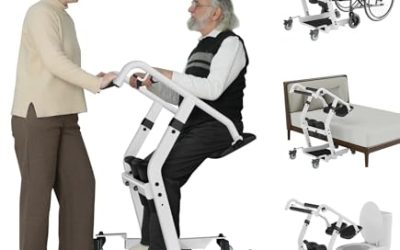
A patient transfer chair is a medical support device, not ordinary furniture. Its job is to move a person who cannot safely transfer alone between a bed, a wheelchair, a sofa, a toilet and, for some models, a car seat — without the caregiver lifting the person’s full weight by hand. That job puts real load through the frame, seat, casters and the person’s arms, which is why this guide treats two criteria as non-negotiable: the chair must be a genuine patient transfer or lift chair, and it must be compact. Padded armrests are the third required criterion, checked product by product below — including one pick where the listing does not clearly confirm armrest padding, flagged openly rather than smoothed over.
No office or dining chairs appear here. A chair that cannot lift, split, roll and lock for a transfer is not a transfer chair, however comfortable its arms are. Every pick below is a wheeled patient lift transfer chair sold for bed, wheelchair, toilet and home-care transfers.
This article does not give personal medical advice. Whether a transfer chair is suitable depends on the individual user’s weight, ability to sit up, trunk control, skin condition and home layout. Check the stated weight capacity against the actual user, with a safety margin, and discuss the user’s specific needs with a clinician, occupational therapist or other qualified professional before buying or using a device like this — especially if the user cannot sit up independently, has had recent surgery, or has pressure-injury risk. Several listings below state plainly that their chair is not suitable for people who are completely paralysed or cannot sit up, and those limits must be respected.
Quick Comparison
| Pick | Lift type | Capacity on listing | Compact evidence on listing | Padded armrests |
|---|---|---|---|---|
| Foldable Electric Patient Lift Transfer Chair (HOMMMLY / BNDDUP listing) | Electric, button control | Not stated in the indexed summary we read — confirm on the live page | Foldable; product weight 69.3 lb; package 36 x 27 x 18 in | Yes — listing describes soft foam armrests |
| Achairgo Patient Lift Transfer Chair | Electric assist | 290 lb | Folds to 36.2 x 23.6 x 15.33 in; product weight 75 lb | Not clearly confirmed in the listing text we read — see the flag in its section |
| LCDOCTOR Patient Lift Transfer Chair | Manual lift transfer chair | 275 lb | Product weight 50 lb; listed size 30 in (W) x 31 in (D) | Arm Pad listed among included components; related LCDOCTOR listing text describes soft padded armrests |
Capacities, dimensions and weights are the makers’ figures as shown on each Amazon US listing. Where a figure could not be confirmed from the listing text we could read, the table says so instead of filling the gap with a guess.
1. Foldable Electric Patient Lift Transfer Chair — ASIN B0F6CXCF76
This foldable electric patient lift transfer chair is the clearest match in this guide for the padded-armrest criterion. Its Amazon listing has a dedicated section for the soft armrest, describing armrests made of soft foam material designed to provide comfortable support and protection for the patient’s arms and to reduce pressure on the arms and wrists. The same listing describes a soft backrest in high-density sponge. For a person who grips or leans on the armrests during every transfer, that padding is not decoration: it is the surface their forearms press into while the chair is raised, lowered and moved.
The lift is electric. The listing gives an adjustable height range of 32 to 45.8 inches and an adjustable base width of 21.7 to 45.2 inches, controlled for lifting by a button on the removable battery, with a quiet motor in the maker’s description. Adjustable base width is what lets the chair legs straddle or fit around different wheelchairs, beds and toilets, and the listing walks through use cases for bed, wheelchair, sofa, dining room, toilet and car transfers, including a commode-style seat with an opening and a second solid cushion for ordinary transfers.
Compactness comes from folding. The listing describes a foldable device with armrest folding fixing holes that keep the armrests stable when the chair is folded and transported in a vehicle, gives a product weight of 69.3 pounds, and gives a package size of 36 x 27 x 18 inches. At nearly 70 pounds this is compact in footprint, not light in absolute terms — a caregiver still has to be able to handle that weight when loading it into a car.
The limits on this listing are as important as the features, and they are stated by the seller. The gap under the bed needs to be high enough for the base — the listing gives figures around 4.7 to 5 inches of clearance in different places, so measure your bed base and use the larger figure to be safe. The patient needs to be able to sit up independently, and the chair is not suitable for completely paralysed patients. Small casters cannot walk on carpets, door width needs to be over 26 inches for the routes the listing describes, and car use depends on door width and seat height limits given on the page. Read those conditions against your actual home before ordering; a transfer chair that cannot pass your bathroom door or fit under your bed does not solve the transfer problem it was bought for.
One more honesty note: in one indexed version of this listing, the summary reported no featured offers available, and the live Amazon page could not be read directly during our check. Confirm current availability and the exact seller, capacity figure and price on Amazon before relying on this pick, and see the accompanying notes for the evidence level recorded for it.
Who should consider it: a caregiver who wants electric lifting, folding storage and transport, and the most clearly documented padded — soft foam — armrests in this guide. Who should skip it: anyone caring for a person who cannot sit up independently, anyone whose home has thick carpet on the transfer route, narrow doors, or a bed base with low clearance.
2. Achairgo Patient Lift Transfer Chair, Electric Assist — ASIN B0D83SYJ6D
The Achairgo Patient Lift Transfer Chair is an electric assist lift aid for home care, described on its listing for transfers between wheelchairs, sofas, beds, cars, toilets and bathrooms, and for use as a transfer chair, bathing chair, commode chair and indoor wheelchair. Its headline compact figure is its folded size: 36.2 x 23.6 x 15.33 inches, which the listing says fits into the trunk of most cars. The product weight is 75 pounds and the maximum load given on the listing is 290 pounds.
The lift range given is 33.86 to 47.64 inches, operated with one-button electric lifting, and the base width adjusts from 19.68 to 33.46 inches with a joystick-style adjustment in the listing description. That is a taller maximum lift height than the first pick, which may matter for higher beds. The listing describes three seat cushions in the box — a solid cushion, a soft cushion, and a soft cushion with a hole for commode use — plus a backrest and a user manual, an extended long soft backrest, four wheels with brakes and non-slip locking swivel casters, a battery level indicator, and a steel main body. The listing also says the whole machine is water resistant and can be used as a shower chair without removing the battery first; treat that as a maker claim to verify against the current manual, not as a general instruction for electric devices around water.
Now the flag this guide promised. Padded armrests are not clearly confirmed for this model in the listing text we could read. The listing documents a soft backrest and soft cushions in detail, and a question-and-answer exchange on the page discusses the distance between the armrests — about 20 inches between them, with each side about 18 inches in the answer given — which confirms armrests exist and gives a useful fit measurement for the user’s body width. It does not, in the text we read, describe those armrests as padded or foam-covered. Under the rule for this guide, that is a shortcoming to state, not a detail to assume. If padded armrests are essential for the user — for example because of fragile skin, bony forearms or pain on pressure — either confirm the armrest construction directly with the seller before ordering this model, or choose the first pick, where soft foam armrests are explicitly described.
Who should consider it: a caregiver who prioritises the tallest lift range here, a documented 290-pound capacity, a folding size stated for car trunks, and a full set of three cushions including a commode cushion. Who should skip it: anyone for whom confirmed padded armrests are a must-have and who cannot get that confirmation from the seller, and anyone who cannot manage a 75-pound device when folding and loading it.
3. LCDOCTOR Patient Lift Transfer Chair — ASIN B0FJMBPP7Z
The LCDOCTOR Patient Lift Transfer Chair is the lightest pick in this guide at a listed item weight of 50 pounds, with a maximum weight recommendation of 275 pounds on its Amazon listing. The listed size is 30 inches wide by 31 inches deep, with overall item dimensions given as 31 x 30 x 17 inches in the product information — figures that do not perfectly agree with each other, so measure the space the chair must pass through and store in, and confirm the exact folded and assembled dimensions with the seller if a doorway is tight. The frame material is listed as alloy steel with an iron material listing, the seat material as fabric with foam fill, and the included components are listed as Arm Pad, Caster, Cushion and Ottoman.
That Arm Pad component matters for this guide’s criterion. The listing for this model includes an arm pad in the box, and listing text for the LCDOCTOR patient lift transfer chair with padded backrest describes armrests designed with soft padding for a more comfortable grip, a padded support board in the upgraded backrest, and a padded seat cushion, on a high-strength steel tube frame rated in that text at up to 275 pounds — the same capacity as this model. Taken together, that supports treating this chair as having padded armrests, but the evidence is thinner than for the first pick: it rests on the included Arm Pad component on this ASIN’s listing plus soft-padding armrest language in related LCDOCTOR listing text, rather than a dedicated soft-armrest section on this exact page. The accompanying notes record that distinction, and buyers for whom armrest padding is critical should confirm it on the live page or with the seller.
Functionally, the listing describes this chair as a transfer chair for seniors and people with disabilities, a lift assist chair, and a transfer wheelchair to car device, for smoother transfers between beds, wheelchairs and toilets, intended to reduce lifting strain and help prevent falls for caregivers in homes, hospitals and care environments. The back style is listed as a pillow back and the style as a sit-to-stand lift aid. Assembly is listed as not required in the product information we read, which, if it holds for the delivered unit, is a genuine practical advantage for a 50-pound medical device.
Who should consider it: a caregiver who needs the lightest transfer chair in this guide, can work within a 275-pound capacity, and values the included arm pad, cushion and ottoman components. Who should skip it: anyone whose user is close to or above 275 pounds — capacity is a hard safety limit, not a guideline — and anyone who needs electric lifting, since nothing in the listing text we read describes a motor for this model.
How to Choose a Compact Patient Transfer Chair With Padded Armrests
Check capacity first, with margin. Find the maximum weight recommendation on the listing — 290 pounds for the Achairgo and 275 pounds for the LCDOCTOR in this guide — and compare it with the user’s actual weight plus anything they will hold or wear during transfer. If the user is near the limit, do not buy that model. Capacity is set by the frame, seat supports and casters, and exceeding it risks device failure during the most vulnerable moment of a transfer.
Confirm the user can use a transfer chair at all. These chairs generally require the person to be able to sit up, and listings state they are not suitable for complete paralysis. A person who cannot sit, who has uncontrolled movements, or who has specific post-surgical precautions may need a different device, such as a full sling lift, assessed by a professional. This is a decision to make with a clinician or therapist who knows the user, not from a buying guide.
Measure the home, not just the chair. Compact should mean three measured things: the folded size for storage and car transport, the assembled width against your narrowest door on the transfer route, and the base clearance under your bed and sofa. The listings here give folded sizes around 36 inches long, door-width needs over 26 inches, and bed-base clearance needs around 5 inches. A tape measure used before ordering is worth more than any feature list.
Verify padded armrests in words, not in photos. Photos can make hard plastic look soft. Look for listing language that actually says soft, foam or padded for the armrests, or a named arm pad among the included components, as documented — and, for the Achairgo, not documented — above. If the text is silent, ask the seller and keep the answer.
Check the floor and the brakes. Small swivel casters are for hard, flat indoor floors; listings warn against carpet. Confirm every caster can lock, test the brakes before the first transfer with a user in the chair, and plan a route without thresholds or rugs that a small caster will catch on.
Plan the toileting and bathing use honestly. Split-seat and commode-cushion designs can remove a separate transfer to a toilet chair, which is a real benefit, but only if the chair fits around your specific toilet and the caregiver is comfortable with the hygiene routine for cushions and openings. Water-resistant claims for electric models should be checked against the current manual before any shower use.
Frequently Asked Questions
Are padded armrests really necessary on a transfer chair? For many users they make a practical difference, because forearms rest and push on the armrests during lifting and lowering, and hard narrow armrests concentrate pressure. For users with fragile skin, low body weight or arm pain, padding matters more. It is still only one factor — capacity, fit and the user’s ability to sit up come first.
Can one caregiver operate these chairs alone? The listings describe these devices as caregiver aids that reduce manual lifting, and electric models replace lifting effort with button-controlled lifting. Whether one caregiver is enough depends on the user’s weight, cooperation and condition and on the setting’s own care policies. Follow the maker’s instructions and, where the user has a care plan, the guidance of the professionals who wrote it.
Will a compact transfer chair fit in a car? Folding models here state folded sizes of about 36 inches in their longest dimension and describe trunk transport, but they weigh 50 to 75 pounds. Check both the trunk opening and your ability to lift the folded chair safely before counting on car use.
Can these chairs be used on carpet? The listings warn that small casters cannot walk on carpet. Plan transfers on hard, flat floors, and treat a carpeted route as a reason to choose a different transfer solution or change the route.
Bottom Line
For the clearest padded-armrest evidence, the Foldable Electric Patient Lift Transfer Chair (B0F6CXCF76) leads this guide, with soft foam armrests described in its own listing, electric height adjustment and a folding design — subject to confirming its current availability and capacity on Amazon. For the tallest lift range and a stated 290-pound capacity in a folding electric chair, the Achairgo (B0D83SYJ6D) is the alternative, with the explicit caveat that its listing text does not clearly confirm padded armrests. For the lightest option at 50 pounds and a 275-pound capacity, the LCDOCTOR (B0FJMBPP7Z) includes an Arm Pad among its components, with thinner armrest-padding evidence than the first pick. Whichever you consider, verify capacity, folded size, door and bed clearances, and armrest padding on the live listing, and check suitability for the individual user with a qualified professional before you buy.
More from Amazon
Programs that pair well with the guide above. Offers and eligibility are set by Amazon and may change.
Set up recurring deliveries of everyday items on eligible products. Terms and savings are set by Amazon.
Explore Subscribe & SaveFree shipping on eligible items, Prime Video and more. Eligible new members can start with a free trial.
Start a Prime free trialA Prime membership for ages 18-24 with a trial period. Eligibility is set by Amazon.
See Prime for Young AdultsAudiobooks and podcasts to listen to on the go. Eligible new members can start with a free trial.
Try Audible freeAs an Amazon Associate we earn from qualifying purchases.



Write Your Review
No reviews yet. Be the first to share your experience!