

Key takeaways
- Compare the best wheeled patient transfer chairs with locking casters: 5 chairs, capacities, caster locks, and what to check before buying.
Moving a loved one from a bed to a wheelchair, a wheelchair to a toilet, or a chair to a car seat is one of the most demanding parts of home caregiving. A wheeled patient transfer chair is built for exactly that job: it rolls the person, seated, across a short distance instead of asking the caregiver to lift or pivot them by hand. The locking casters are the feature that makes the whole idea work. When the brakes are engaged, the chair is meant to stay put while the person gets on or off; when they are released, the chair rolls freely to the next stop.


This guide covers only wheeled patient transfer chairs whose listings describe locking casters — seated transfer devices, not standard wheelchairs, recliners, or sling lifts. Specs come from the sellers’ Amazon listings, and nothing here is presented as a practical test result. If you are unsure whether a transfer chair suits someone’s condition, ask their doctor, physical therapist, or occupational therapist before buying.
Disclosure: As an Amazon Associate, we earn from qualifying purchases made through links on this page, at no extra cost to you.
Quick Picks
Our Short List of 3
- Best for: Caregivers helping someone who can bear some weight and follow instructions. Note that no safety belt is included, and VOCIC sells several AY03 variants, so confirm the exact model on the listing.
- Stated capacity: 400 lbs
- Frame: Reinforced high-grade steel
- Casters: Rear 3-inch, front 4-inch, dual-lock braking
- Knee pad adjustment: 2 levels, 51–56 cm
- Best for: Households that want a single chair to cover transfers, showering, and toileting. Measure doorways and bathroom clearances before ordering.
- Stated capacity: 450 lbs in the title; 440 lbs in the description (confirm on the listing)
- Functions: Wheelchair, shower chair, commode chair, transfer aid, bedside commode
- Casters: Four 360-degree universal casters with push-to-lock brakes; dual rear brakes
- Height adjustment: 5 levels; removable armrests

- Best for: Caregivers who prefer a simple mechanical chair with no charging and need a split seat for bed-to-chair transfers. The 275 lb capacity is the lowest in this guide, and manual cranking demands more caregiver effort than a powered lift.
- Stated capacity: 275 lbs
- Lift type: Manual crank
- Seat: 180-degree split seat; height 16.5–23.6 inches; rear safety latch
- Casters: 4 locking casters
All 5 Picks at a Glance
| Product | Specs | Action |
|---|---|---|
| 1. VOCIC Sit to Stand Lift AY03 2026 Upgraded |
| Check price on Amazon |
| 2. Drexo Patient Lift Transfer Chair 5-in-1 |
| Check price on Amazon |
| 3. UJQNBM Patient Lift Transfer Chair, Manual Crank |
| Check price on Amazon |
 4. VEVOR Electric Patient Lift Transfer Chair YW03 |
| Check price on Amazon |
 5. Hybodies Patient Lift Wheelchair 4-in-1 |
| Check price on Amazon |
A note on verification: Amazon returned a 403 access error when we tried to open each product page directly on November 25, 2026, so we could not confirm live price or stock on the product pages themselves. The products below are therefore marked UNABLE TO VERIFY by direct page check. Each ASIN was matched through Amazon search-listing results instead, which is weaker evidence. Please confirm the current price, availability, and exact specifications on Amazon before ordering.
1. VOCIC Sit to Stand Lift AY03 2026 Upgraded
- Best for: Caregivers helping someone who can bear some weight and follow instructions. Note that no safety belt is included, and VOCIC sells several AY03 variants, so confirm the exact model on the listing.
- Stated capacity: 400 lbs
- Frame: Reinforced high-grade steel
- Casters: Rear 3-inch, front 4-inch, dual-lock braking
- Knee pad adjustment: 2 levels, 51–56 cm
Caregivers helping someone who can bear some weight and follow instructions. Note that no safety belt is included, and VOCIC sells several AY03 variants, so confirm the exact model on the listing.
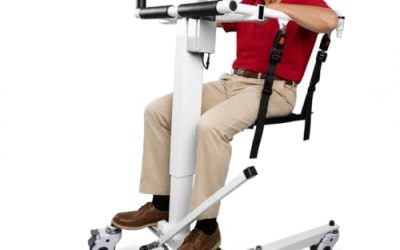
The VOCIC AY03 is a sit-to-stand transfer aid for people who can sit upright and support their own upper body. Rather than lifting the person in a sling, it gives them a stable frame, a padded seat, knee pads, and handles so they can rise with assistance and then be rolled to the next spot. The listing states a weight capacity of 400 lbs (180 kg) on a reinforced high-grade steel frame.
The caster setup is one of the clearest in this roundup. The rear casters measure 3 inches and the front casters measure 4 inches, and the listing describes a dual-lock safety braking system that locks the casters in place to prevent unwanted sliding or shifting during positioning. Knee-pad height adjusts across two levels in a 51 to 56 cm range, and the base sits low, at about 6 cm, which the seller presents as helpful for sliding the base close to beds and chairs.
There are two limits worth knowing before you buy. First, the listing states that this product does not include or support a safety belt restraint, and that it is intended only for people who can sit up and support their own core upper body. It is not recommended for completely immobile or paralyzed patients. Second, one buyer review quoted in search results reported a front-wheel locking mechanism breaking after several months of use, which is a reminder to test every caster lock on arrival and to keep the chair out of service if a lock stops holding.
2. Drexo Patient Lift Transfer Chair 5-in-1
- Best for: Households that want a single chair to cover transfers, showering, and toileting. Measure doorways and bathroom clearances before ordering.
- Stated capacity: 450 lbs in the title; 440 lbs in the description (confirm on the listing)
- Functions: Wheelchair, shower chair, commode chair, transfer aid, bedside commode
- Casters: Four 360-degree universal casters with push-to-lock brakes; dual rear brakes
- Height adjustment: 5 levels; removable armrests
Households that want a single chair to cover transfers, showering, and toileting. Measure doorways and bathroom clearances before ordering.
The Drexo 5-in-1 is the most multi-purpose chair in this guide. According to its listing, it converts between five roles: wheelchair, shower chair, commode chair, transfer aid, and bedside commode. That breadth matters in a small home, where one device that covers toileting and bathing as well as transfers can replace two or three separate pieces of equipment.
Its caster system is described as four 360-degree universal casters with push-to-lock brakes, plus dual rear brakes for stability during transfers. The listing also describes an anti-slip tread on the wheels and a heavy-duty safety strap that secures the user to the chair’s D-ring anchors. Height adjusts across five levels, and the armrests are removable, which helps with side transfers onto a bed or toilet.
One detail needs care. The product title lists a maximum load of 450 lbs, while the listing description states support for up to 440 lbs. Capacity is not a number to guess at, so confirm the exact rated capacity on the Amazon listing before ordering, and stay well within the lower figure if the two numbers still disagree.
3. UJQNBM Patient Lift Transfer Chair, Manual Crank
- Best for: Caregivers who prefer a simple mechanical chair with no charging and need a split seat for bed-to-chair transfers. The 275 lb capacity is the lowest in this guide, and manual cranking demands more caregiver effort than a powered lift.
- Stated capacity: 275 lbs
- Lift type: Manual crank
- Seat: 180-degree split seat; height 16.5–23.6 inches; rear safety latch
- Casters: 4 locking casters
Caregivers who prefer a simple mechanical chair with no charging and need a split seat for bed-to-chair transfers. The 275 lb capacity is the lowest in this guide, and manual cranking demands more caregiver effort than a powered lift.
The UJQNBM chair is the manual option in this roundup: it raises and lowers with a hand crank instead of a motor or battery. For some households that is a real advantage. There is nothing to charge, no battery to wear out, and no motor noise, which can matter for overnight or early-morning transfers. The listing states a 275 lb capacity.
Its transfer design centers on a 180-degree split seat that opens so the chair can slide under or around a seated person, plus a rear safety latch. Seat height adjusts from 16.5 to 23.6 inches, which covers a useful range of bed and sofa heights. The listing specifies 4 locking casters, and the chair ships with a commode bucket, a cushion, and a footrest. Listed dimensions are 23.6 x 20 x 31.4 inches, and the listed weight is 55 pounds, so it is not a lightweight chair to carry, even though it rolls.
Because the listing first appeared on Amazon on October 16, 2026, it is a newer product with less of a track record than the established brands here. That is not a reason to reject it, but it is a reason to read the manual carefully and test the crank and every caster lock before first use with a person seated.
4. VEVOR Electric Patient Lift Transfer Chair YW03
- Best for: Caregivers of a smaller adult who want powered lifting and a chair that can double as a bedside commode. The 220 lb stated capacity is the lowest here, so confirm the battery, charging, and manual-override details in the listing and manual before relying on it daily.
- Stated capacity: 220 lbs
- Lift type: Electric, one-button operation
- Seat: 180-degree split seat with bedpan
- Casters: Locking swivel casters
Caregivers of a smaller adult who want powered lifting and a chair that can double as a bedside commode. The 220 lb stated capacity is the lowest here, so confirm the battery, charging, and manual-override details in the listing and manual before relying on it daily.
The VEVOR YW03 is the powered option for caregivers who want the lifting done by a motor. One-button electric lifting raises the seat, and the listing describes a 180-degree split seat with a bedpan, so the chair can serve as a bedside commode as well as a transfer device. It carries an IP44 waterproof rating and a battery level indicator, and the seller states a fast-charging battery of about 4 hours.
The listing describes locking swivel casters, a thick soft cushion, and a battery indicator so the caregiver can see charge status at a glance. At a stated capacity of 220 lbs, it is the lowest-capacity chair in this guide by a clear margin, so it suits smaller users and is not appropriate for anyone near or above that limit.
5. Hybodies Patient Lift Wheelchair 4-in-1
- Best for: Households that need one chair to move between bedroom, bathroom, and toilet, with hydraulic height adjustment and no battery to manage. Measure under-bed and under-sofa clearance first, because the base needs a specific gap to slide under furniture.
- Stated capacity: 330 lbs
- Lift type: Hydraulic pump, seat height 18.1–25.9 inches
- Seat: 180-degree double-sided opening
- Casters: Lockable wheels
Households that need one chair to move between bedroom, bathroom, and toilet, with hydraulic height adjustment and no battery to manage. Measure under-bed and under-sofa clearance first, because the base needs a specific gap to slide under furniture.
The Hybodies 4-in-1 combines a patient lift wheelchair, a bedside commode, a shower chair, and a raised toilet seat in one frame. Its headline feature is a hydraulic pump that adjusts seat height smoothly, listed from 18.1 to 25.9 inches, so the caregiver can match the seat to a bed, sofa, or toilet without cranking or plugging anything in.
The transfer design uses a 180-degree double-sided opening seat, a reinforced metal structure, and lockable wheels that the listing says provide added stability during transfers. Comfort details in the listing include a front standing handgrip, side armrests, a PU backrest, and non-slip footrests. Stated capacity is 330 lbs. The listing also notes the base needs at least 5.4 inches of clearance under sofas or beds, with furniture thickness between 12.2 and 20.6 inches, so measuring the actual furniture before ordering is essential.
How to Choose a Wheeled Patient Transfer Chair With Locking Casters
Start with capacity, and leave a margin. The stated capacity is a maximum, not a target. Add the person’s weight plus clothing and any cushion, then choose a chair rated comfortably above that total. A chair rated at 220 lbs is not the right choice for a 210 lb person, because real transfers involve shifting weight and uneven loading.
Test every caster lock before the first real transfer. Locking casters are the defining feature of this category, but locks differ: some use a foot pedal on each wheel, some use a dual-lock system that brakes both the wheel and the swivel, and some lock only some of the wheels. When the chair arrives, engage each lock on a hard floor, push the chair from several directions, and confirm it does not roll or swivel. If any lock feels loose, slips, or fails to engage, do not use the chair with a person in it until the problem is resolved.
Match the chair to the person’s abilities. Sit-to-stand aids like the VOCIC AY03 assume the person can sit upright, grip handles, and support their own upper body. Split-seat lift chairs assume the person can be positioned onto the seat with caregiver help and can sit safely while the chair moves. Nobody should use a transfer chair as a substitute for professional assessment. If the person cannot sit upright, cannot follow instructions, or has a condition that affects balance or skin integrity, ask a doctor or therapist which type of equipment is appropriate before buying.
Decide between manual, hydraulic, and electric lifting. Manual crank chairs have no battery to charge but demand the most caregiver effort. Hydraulic chairs sit in the middle: smooth height adjustment with no charging. Electric chairs do the lifting for you but depend on a charged battery. Think about who will operate the chair and how often transfers happen each day.
Check the floor surface and the whole route. Small casters roll well on tile, wood, and vinyl, and poorly on thick carpet. Keep the chair’s brakes locked whenever someone is getting on or off, unlock them only when the chair is ready to roll with the caregiver in control, and keep a clear path with a second person nearby for the first few transfers until everyone is confident.
Frequently Asked Questions
What is a wheeled patient transfer chair with locking casters?
It is a seated mobility aid that rolls a person across short distances, for example from a bed to a wheelchair or to a toilet, and has caster wheels with brakes that lock the chair in place during transfers. The locks are meant to keep the chair still while the person gets on or off, and to be released only when the caregiver is ready to roll the chair.
Are locking casters the same as regular wheelchair brakes?
No. A wheelchair brake usually locks the large rear wheels, while a transfer chair’s locking casters brake the small swivel wheels that the chair rolls on. Some chairs lock both the rolling and the swivel motion of each caster, which gives a more stable parked position. Always check how many casters lock on the model you are considering, because some designs lock only the rear pair.
Can a patient transfer chair replace a wheelchair?
Generally not. Transfer chairs are designed for short, caregiver-assisted moves inside the home, not for all-day seating, outdoor use, or self-propulsion. They usually lack the large rear wheels, pressure-relief seating, and postural support of a full wheelchair. If the person needs a chair for extended sitting or independent movement, a wheelchair or a clinician-recommended seating system is usually more appropriate.
How do I know if a transfer chair will fit through my doorways?
Measure the narrowest doorway on the planned route and compare it with the chair’s listed overall width, allowing a little extra clearance for hands and turning. Also measure the gap under the bed or sofa if the chair’s base needs to slide underneath, and the height of each surface the person will transfer to and from.
Do I need a doctor’s approval to buy a transfer chair?
No prescription is usually required to buy one, but that does not mean any chair suits any person. Transfer equipment is used by people with medical conditions, and the wrong type can lead to falls or injury. If you are unsure which design fits the person’s strength, balance, weight, or condition, ask their doctor, physical therapist, or occupational therapist before ordering.
Conclusion
The best wheeled patient transfer chair with locking casters is the one that matches the person, the caregiver, and the home at the same time. The VOCIC AY03 stands out for sit-to-stand transfers where the user can support their upper body, thanks to its 400 lb capacity and clearly described dual-lock casters. The Drexo 5-in-1 covers the most roles in a single frame, while the UJQNBM manual crank chair keeps things simple with no battery to charge. The VEVOR YW03 adds powered lifting for smaller users, and the Hybodies 4-in-1 offers hydraulic height adjustment across bed, bath, and commode use.
Whichever model you consider, treat the caster locks as the feature that matters most: test every lock on arrival, keep the brakes engaged for every get-on and get-off, and re-check them often. Confirm the live price, stock, capacity, and dimensions on the Amazon listing before you order, since our direct page checks were blocked and the listings are the final authority. When there is any doubt about whether a transfer chair is right for someone’s condition, a clinician’s advice is worth more than any product page.
More from Amazon
Programs that pair well with the guide above. Offers and eligibility are set by Amazon and may change.
Set up recurring deliveries of everyday items on eligible products. Terms and savings are set by Amazon.
Explore Subscribe & SaveFree shipping on eligible items, Prime Video and more. Eligible new members can start with a free trial.
Start a Prime free trialA Prime membership for ages 18-24 with a trial period. Eligibility is set by Amazon.
See Prime for Young AdultsAudiobooks and podcasts to listen to on the go. Eligible new members can start with a free trial.
Try Audible freeAs an Amazon Associate we earn from qualifying purchases.



Write Your Review
No reviews yet. Be the first to share your experience!