

Key takeaways
- Pro: power recline, swivel and glide in one chair
- Pro: stain-resistant fabric and low-emission certifications
- Pro: includes a USB port and a lumbar pillow according to reviewer summaries
- Con: needs a nearby wall outlet
- Con: heavy at more than 120 pounds, so moving it is a two-person job
- Con: the seat feels narrow to some larger adults and cushions are firm at first
The best nursery rocking chair for most families is a glider-style chair with a swivel base and an optional recline, such as the Babyletto Kiwi, because the smooth, quiet motion does not need floor clearance behind the chair. If you specifically want a true rocker on curved legs for a classic look and a tighter budget, the Nursery Works Sleepytime Rocker and the Delta Children Emma Rocker are the realistic choices. Which one fits depends on how much floor space you have, how long your feeding sessions run, and whether you need a recline for naps and night wakings.
Our top picks


As an Amazon Associate we earn from qualifying purchases at no extra cost to you.
Quick Comparison of the Picks
| Pick | Best for | Motion | Key numbers | Price tier |
|---|---|---|---|---|
| Babyletto Kiwi Electronic Recliner and Swivel Glider | Best overall | Glide, 270-degree swivel, power recline | 300 lb capacity, about 41 x 29 x 36 in., Greenguard Gold | Premium |
| Graco Teddi Power Recliner Swivel Glider | Best deep-cushion recliner | Glide, swivel, power recline | About 97 lb, about 39 in. deep, USB-A and USB-C | Mid-range to premium |
| Storkcraft Premium Hoop Glider and Ottoman | Best budget set | Glide only | 250 lb capacity, 17.5 in. seat height, ottoman included | Budget |
| Delta Children Blair Slim Nursery Glider Swivel | Best for small rooms | Glide, swivel | 26.5 in. wide, 31.5 in. deep, 22 in. backrest | Budget to mid-range |
| Nursery Works Sleepytime Rocker | Best true rocker | Rock on curved legs | About 50 lb, 17.5 in. seat height, Greenguard Gold | Mid-range |
| Delta Children Emma Rocker | Best classic low-cost rocker | Traditional rock | Removable washable cushion | Budget |
| Oxford Baby Uptown Glider Recliner Rocking | Best three-motion combo | Glide, rock, 360-degree swivel, manual recline | 250 lb capacity, metal base, Greenguard Gold | Mid-range |
Specifications come from manufacturer pages and published buying guides. Furniture makers revise fabrics and hardware often, so confirm dimensions and certifications on the exact version you order.
Rocker or Glider: What Is the Real Difference?
People use the phrase nursery rocking chair for two very different mechanisms. A true rocker sits on curved runners or legs and swings your whole body in an arc, which means the chair travels forward and back across the floor. A glider hangs the seat from a linkage or sits it on a track so the seat moves forward and back while the base stays put. Gliders need less clearance, are generally quieter and are easier on the back of a tired parent because the motion is flatter.
Floor space and wall clearance
A traditional rocker needs room behind it, commonly several inches to a foot depending on the design, or the back legs will thump the wall as you rock. A glider keeps the base stationary, so it can sit closer to a crib or window. If your nursery is under 10 by 10 feet, that difference matters more than the finish of the wood.
Noise and the sleeping baby
Wooden runners can creak on hardwood and slide on bare floors, while a glider’s bearings are usually quiet. A rug pad under rocker runners reduces both noise and creep. Test the chair at the same speed you would use at 3 a.m., not the speed of a showroom bounce.
Recline and swivel
A recline lets you lean back during long feeding sessions and then support a sleeping baby on your chest. A swivel makes it easy to turn toward the crib or the door. Power recline models are the quietest because the backrest moves without you shifting your weight, but they need an outlet within reach of the cord.
Best Overall: Babyletto Kiwi Electronic Recliner and Swivel Glider
The Kiwi combines a smooth glide, a 270-degree swivel and a power recline that moves at the push of a button. Published guides list it with a 300-pound weight capacity, dimensions of roughly 41 by 29 by 36 inches and a weight of about 120 pounds, with Greenguard Gold and CertiPUR-US certifications and a water-repellent recycled-polyester fabric.
Who it is for
Parents who want one chair that survives the newborn months and then moves to a living room or reading corner. The power recline lets you change position without waking a baby, and the low flat arms suit nursing pillows.
Pros and cons
- Pro: power recline, swivel and glide in one chair
- Pro: stain-resistant fabric and low-emission certifications
- Pro: includes a USB port and a lumbar pillow according to reviewer summaries
- Con: needs a nearby wall outlet
- Con: heavy at more than 120 pounds, so moving it is a two-person job
- Con: the seat feels narrow to some larger adults and cushions are firm at first
Best Deep-Cushion Recliner: Graco Teddi Power Recliner Swivel Glider
The Teddi is a power recliner glider with high-resilience foam over a pocket-coil spring, steel base, and both USB-A and USB-C ports. Published guides give a weight of about 97 pounds and a depth near 39 inches, with CertiPUR-US and Oeko-Tex Standard 100 credentials. The ivory bouclé look suits modern nurseries.
Who it is for
Parents who prefer a plush seat and expect to use the chair for hours at a time. Coil construction tends to resist the permanent dents that appear in foam-only cushions.
Pros and cons
- Pro: deeper cushioning than many compact gliders
- Pro: two charging ports so a phone or monitor stays powered
- Con: large footprint at about 39 inches deep
- Con: bouclé fabric traps spills, so use a throw or a cleaning kit
- Con: needs an outlet for the recline
Best Budget Set: Storkcraft Premium Hoop Glider and Ottoman
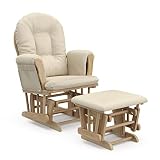
This is a glide-only chair with a solid wood frame, a matching gliding ottoman and side storage pockets. Guides list a 17.5-inch seat height, an 18.7-inch seat depth, Greenguard Gold certification and a 250-pound weight capacity.
Who it is for
First-time parents who want the ottoman included and a classic look at a lower price tier. It fits well when you do not need to swivel or recline.
Pros and cons
- Pro: ottoman included in the set
- Pro: solid wood frame and Greenguard Gold certification
- Pro: smooth glide with storage pockets for burp cloths
- Con: no swivel or recline
- Con: thinner cushions can feel flat after long feeds
- Con: fabric is spot-clean only and assembly is more involved
Best for Small Rooms: Delta Children Blair Slim Nursery Glider Swivel
The Blair Slim is designed for tight spaces. Dimensions are listed at about 26.5 inches wide and 31.5 inches deep, with a 22-inch backrest, padded arms, steel mechanisms and a seat cushion about 5.5 inches thick that can be removed for cleaning. It swivels and glides but does not recline.
Who it is for
Apartment nurseries and shared bedrooms where a standard glider recliner would crowd the crib. It also suits a smaller parent who finds wide arms awkward.
Pros and cons
- Pro: narrow profile and removable cushion
- Pro: steel mechanisms feel durable for the class
- Con: no recline and no ottoman
- Con: seat is tight for broader adults
- Con: not listed with Greenguard Gold, so check emissions labels if that matters to you
Best True Rocker: Nursery Works Sleepytime Rocker
The Sleepytime Rocker rocks on curved rubberwood legs rather than a glider mechanism. Published specs describe a weight of about 50 pounds, a 17.5-inch seat height, tool-free setup and Greenguard Gold, CertiPUR-US and FSC credentials. The upholstered seat looks more like living room furniture than medical-style nursery equipment.
Who it is for
Parents who like the feel of an actual rocker and have a room with some space behind the chair. At 50 pounds it is easy to carry to another room when the nursery phase ends.
Pros and cons
- Pro: lightweight and quick to set up
- Pro: low-emission and sustainable-wood certifications
- Con: no swivel and no recline
- Con: needs more floor clearance than any glider
- Con: bouclé upholstery can trap spills
Best Classic Low-Cost Rocker: Delta Children Emma Rocker
The Emma Rocker is a traditional rocking chair with a removable washable cushion and simple operation. It does not swivel or recline, and the rocking arc needs clearance behind it. Because published sources list few measurements for this chair, check the retailer spec sheet for exact width and weight capacity before you buy.
Who it is for
Families who want the old-fashioned rocking motion without paying for power features. It also works as a secondary chair in a bedroom or living room.
Pros and cons
- Pro: classic styling and value pricing
- Pro: removable washable cushion
- Con: limited lumbar support for long sessions
- Con: needs clearance and a rug pad to prevent creeping
Best Three-Motion Combo: Oxford Baby Uptown Glider Recliner Rocking
The Uptown packs glide, rocking, a 360-degree swivel and manual recline positions into one chair, with a solid metal base, side pockets, tool-free assembly and a wipeable polyester cover. Guides list a 250-pound capacity and Greenguard Gold certification.
Who it is for
Parents who want both gentle rocking and gliding in the same chair and prefer to avoid cords. The manual recline works without electricity.
Pros and cons
- Pro: combination of glide, rock, swivel and recline
- Pro: no outlet needed
- Pro: wipeable cover simplifies spills
- Con: manual recline needs a push with your shoulders, which can wake a sleeping baby
- Con: 250-pound limit is lower than the Kiwi
How to Choose a Nursery Rocking Chair
Decision matrix
| Your situation | Best match | Reason |
|---|---|---|
| Night feeds and naps in the chair | Babyletto Kiwi or Graco Teddi | Power recline moves without waking the baby |
| Nursery under 10 x 10 ft | Delta Blair Slim | 26.5 in. wide and 31.5 in. deep |
| Want a true rocking motion | Nursery Works Sleepytime Rocker | Curved legs, lightweight at about 50 lb |
| Tight budget but want an ottoman | Storkcraft Premium Hoop | Matching ottoman included |
| No outlet near the corner | Oxford Baby Uptown | Manual recline, no cord |
| Secondary chair for a bedroom | Delta Emma Rocker | Simple and low-cost |
Seat height and depth
A seat height around 17 to 18 inches suits most adults and keeps your feet flat on the floor or on an ottoman. Seat depth of about 18 to 19 inches supports the thighs without cutting off circulation behind the knees. If you are under about 5 feet 4 inches, a deep seat may leave the lower back unsupported, so add a small cushion.
Arm height for feeding
Low, flat arms around 7 to 9 inches high are a good match for a nursing pillow. High arms push the pillow and baby upward and strain the shoulders over a long session.
Fabric and certification
Look for Greenguard Gold or CertiPUR-US on the label, which relate to emissions and foam content. Performance polyester wipes clean easily, while bouclé and linen blends look softer but hold stains. A removable cushion cover is a practical feature if you expect spit-up.
Worked example: fit check for a small nursery
Say the room is 9 feet by 10 feet, a crib takes 30 by 54 inches along one wall, and a dresser takes 20 inches of depth along another. A recliner glider at 41 inches deep fully reclined adds roughly 20 to 30 inches of extra reach behind the seat. If the corner you picked has only 36 inches of clearance, the chair will bump the wall. Measure the footprint with the recline extended, then compare it with the chair’s published depth. A slim glider at 31.5 inches deep leaves five spare inches in the same space.
Cost per hour of use
Parents commonly spend two to four hours a day in a nursery chair during the first three months. At three hours a day for 90 days, that is 270 hours. A premium chair spread over 270 hours of newborn use plus years of later use as a reading chair costs far less per hour than the sticker suggests, while a budget chair that feels uncomfortable after 20 minutes costs more in sore backs than it saves in money.
Try-before-you-commit checklist
If you can sit in a chair in a store, run through a short routine. Sit with your back fully against the backrest and check that your lower back feels supported without a pillow. Lift your feet and see whether the glide continues smoothly without a jerk at the end of each stroke. Rest your elbows on the arms while holding a pillow the size of a nursing pillow, and note whether your shoulders stay relaxed. Finally, stand up quickly and sit down again a few times, because that is what you will do on nights when the baby wakes repeatedly. If you order online, look for a generous return window, since comfort is personal and heavy furniture is awkward to send back.
Safety and Ownership Realities
- Keep fingers and small hands away from the glider mechanism and the moving parts of a recliner. Never let a toddler play on or under a moving chair.
- Do not fall asleep in a rocking or reclining chair with an infant on your chest. Safe sleep guidance from pediatric organizations recommends putting babies down on their backs in a crib or bassinet.
- Place a non-slip rug pad under a rocker to stop creeping and floor scuffs.
- Check bolts and the glider linkage every few months. Tighten loose fasteners and wipe the mechanism clean of dust.
- Vacuum fabric crevices weekly and spot-clean spills quickly. Follow the care tag, because many nursery fabrics are spot-clean only.
- Foam cushions flatten first at the front edge of the seat. Rotating or flipping a loose cushion extends its comfortable life.
- Check the weight capacity against the heaviest adult who will sit in the chair, including a baby and a nursing pillow.
Frequently Asked Questions
Is a glider better than a rocking chair for a nursery?
For most nurseries, yes. A glider moves the seat without the chair traveling across the floor, so it needs less clearance and tends to be quieter. A true rocker is a good option if you love the traditional motion and have space behind the chair.
Do I need a recliner in a nursery chair?
You do not need one, but a recline helps during long feeds and gives you a more comfortable position when the baby is settled. Power recliners work without shifting your weight, while manual ones need a firmer push.
What size nursery chair fits a small room?
Look for a width near 26 to 27 inches and a depth of about 31 to 32 inches, as with slim glider designs. Always measure the depth with the recline extended and leave at least a few inches behind the chair.
Are gliders safe for babies?
Gliders are designed for adults who hold babies, and they are safe when used as directed. Keep small hands clear of the mechanism, do not allow children to climb on the chair and avoid sleeping with an infant in it.
What certifications should I look for?
Greenguard Gold relates to low chemical emissions for indoor air, and CertiPUR-US relates to foam content. Oeko-Tex Standard 100 covers textiles. These labels do not make a chair medically safer, but they help narrow the field.
How long will a nursery chair stay useful?
A well-made glider or recliner often moves on to a living room or reading corner after the baby grows. Choose a neutral fabric and a frame with a comfortable adult seat height so it keeps its value for years.




Write Your Review
No reviews yet. Be the first to share your experience!