

Key takeaways
- Who it is for: architects, students, and makers who need a reliable range up to about 34 inches.
- Pros: broad seat range, breathable mesh back, adjustable foot ring.
- Cons: spec sheets disagree on capacity; assembly takes time.
The best drafting chair for most people in 2026 is one whose seat range actually reaches your work surface: roughly 24 to 33 inches for a standard drafting table or raised desk, with an adjustable foot ring and a firm back. The Office Star DC2990 is the safest all-round mesh pick, the Flash Furniture BLLB8801X adds lumbar support and synchro tilt, and the Herman Miller Aeron Stool is the premium choice for full-time use.
A drafting chair is not a taller office chair. It is a stool-height seat with a foot ring, because your feet will not reach the floor at 28 inches or more. That changes what matters: the seat range, the foot ring diameter and adjustability, and the base stability become more important than headrests or fancy armrests. The specs below come from manufacturer and retailer listings, and where sources disagree I say so.
Our top picks



As an Amazon Associate we earn from qualifying purchases at no extra cost to you.
Quick Comparison of the Seven Picks
| Pick | Best for | Seat height range | Rated capacity | Price tier |
|---|---|---|---|---|
| Office Star DC2990 Deluxe Mesh | Best overall value | 24.25 to 33.75 in | 250 to 275 lb (listings vary) | Mid |
| Flash Furniture BLLB8801X Mesh | Best lumbar support and tilt | 24.5 to 32 in | 300 lb | Mid |
| Flash Furniture BLZP8805DBK Flip-Up Arms | Best for lower tables | 21.5 to 29 in | 250 lb | Entry to mid |
| Boss B16245 Drafting Stool | Best for labs and studios | 28 to 34 in | 275 lb | Entry to mid |
| Safco Apprentice II Extended-Height | Best budget workshop pick | 22 to 32 in | 250 lb | Entry |
| Safco Precision Extended-Height | Best five-star-base stool | 23 to 33 in | 250 lb | Entry to mid |
| Herman Miller Aeron Stool | Best premium, all-day comfort | 24.75 to 29.25 in (counter) or 28 to 34.25 in (bar) | Manufacturer rated, size B only | Premium |
How to Choose a Drafting Chair
Choosing starts with a single measurement: the height of the surface you work on. Drafting tables, raised workbenches, and sit-stand desks set to standing height all sit between about 36 and 45 inches. A normal 17 to 21 inch office chair leaves you reaching up with your shoulders, which is the problem a drafting chair solves.
Step 1: Find your target seat height
When you sit upright, your elbows sit roughly 8 to 11 inches above the seat for most adults. For keyboard or mouse work, subtract about 10 inches from the surface height. For angled drafting boards you reach over, a seat 2 to 4 inches higher than that formula is common. A worked example: a desk set to 42 inches suggests a seat of about 32 inches, so you want a chair that reaches at least 33 inches at the top of its range and still adjusts a few inches lower for variation through the day.
Step 2: Check the full range, not just the maximum
If you share the chair with someone shorter, or switch between a drafting table and a standard desk, look at the minimum too. The Safco Apprentice II drops to 22 inches, the Flash BLZP8805DBK to 21.5, while the Boss B16245 starts at 28 inches and is best when a stool-height surface is always the target.
Step 3: Confirm the foot ring
The foot ring is your floor. Look for a ring that is height adjustable, at least 18 inches in diameter, and welded or bolted to the column rather than clipped on. Office Star’s DC series rings are listed from roughly 18 to 20 inches depending on retailer, and the Boss B16245 lists a 20-inch chrome ring. Set the ring so your thighs are roughly level or slightly angled down, with your feet resting flat.
Step 4: Match the capacity to the user
Most chairs here are rated for 250 pounds, a few reach 275 or 300. If you are above 250 pounds, look at 300-pound models or the 400-pound big-and-tall class that several manufacturers offer, and verify the gas lift rating. Under heavier loads, gas cylinders and bases fail before the seat does.
Seat height vs. surface height
| Work surface height | Typical seat height needed | Chairs that cover it |
|---|---|---|
| 30 in (standard desk) | Normal task chair, 17 to 21 in | Not needed |
| 36 in (counter-height bench) | 24 to 27 in | Flash BLZP8805DBK, Safco Apprentice II, Aeron Stool (counter) |
| 40 to 42 in (drafting table, raised desk) | 28 to 32 in | Office Star DC2990, Flash BLLB8801X, Safco Precision |
| 44 to 46 in (tall lab bench) | 30 to 34 in | Boss B16245, Aeron Stool (bar), Office Star DC2990 |
Best Overall Value: Office Star DC2990 Deluxe Mesh Drafting Chair
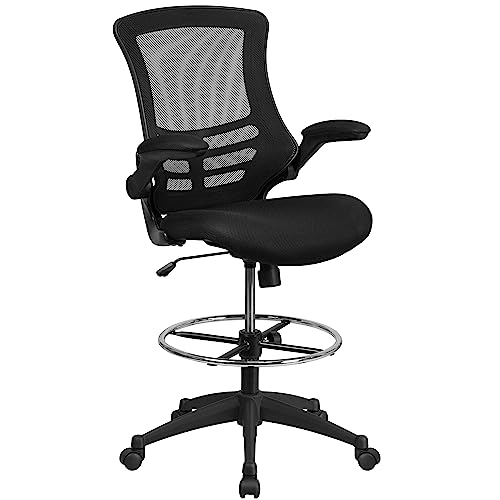
Office Star’s DC2990 is a mesh-back drafting chair with a pneumatic seat that lists a range of 24.25 to 33.75 inches, which covers most drafting tables and raised desks without compromise. It has a chrome, height-adjustable foot ring, a one-touch pneumatic seat control, an adjustable-height back, and a heavy-duty nylon base with dual-wheel carpet casters.
Capacity is quoted differently by sellers. Office Depot lists 250 pounds while another retailer lists 275 pounds for a vinyl version, so assume 250 unless the seller confirms otherwise. Foot ring diameter also varies between listings from about 18 to 20 inches, which is a sign the retailer descriptions are not consistent. Mesh breathes well in warm studios, but cheap mesh can sag over years; the commercial-grade reputation of the DC series and its long warranty on non-moving metal parts is the reason it comes up so often in comparisons.
- Who it is for: architects, students, and makers who need a reliable range up to about 34 inches.
- Pros: broad seat range, breathable mesh back, adjustable foot ring.
- Cons: spec sheets disagree on capacity; assembly takes time.
Best Lumbar Support and Tilt: Flash Furniture BLLB8801X Mesh Drafting Stool
The BLLB8801X is Flash Furniture’s mid-back mesh drafting stool with lumbar support and a synchro-tilt mechanism, offered in black or gray and white. It is listed with a 24.5 to 32 inch seat range and a 300-pound capacity, the highest rating among the Flash models in this guide.
The tilt mechanism is the notable feature. Most drafting chairs sit rigid and force you to lean forward from the hips for hours, which is hard on the lower back. A synchro tilt moves the back and seat together, so the chair follows your posture. The trade-off is that tilt is harder to use at stool height, where your feet are on a ring and not the floor, so many people lock it in a slightly reclined position for reading and unlock it for sketching.
- Who it is for: long sessions at a raised desk, where back support matters.
- Pros: 300 lb capacity, lumbar support, synchro tilt.
- Cons: maximum height stops at 32 inches; tilt takes practice from a foot ring.
Best for Lower Tables: Flash Furniture BLZP8805DBK Flip-Up Arm Drafting Chair
This Flash Furniture model has a mesh back, flip-up arms, and an adjustable foot ring with a seat range of 21.5 to 29 inches and a 250-pound rating. The low end of the range is unusually low for a drafting chair, so it works at a counter-height bench around 36 inches and still handles a taller table with a bit of stretch.
Flip-up arms are useful when a table edge is in the way or you need to slide close to an angled board. They also make it easier to share a station between users of different sizes. Flip-up arms can rattle and loosen over time, so tighten the pivot hardware occasionally. For a tall studio table above 40 inches, move up to a model with a higher ceiling.
- Who it is for: workbenches, craft tables, and counter-height drafting stations.
- Pros: low minimum height, flip-up arms, breathable mesh.
- Cons: 29-inch maximum limits it on tall tables; 250 lb rating.
Best for Labs and Studios: Boss B16245 Drafting Stool
The Boss B16245 is a vinyl drafting stool listed at 28 to 34 inches of seat height, with a 16 by 16 inch seat on a 4-inch molded foam cushion, a 16-inch-wide back cushion, a 20-inch chrome foot ring, and a 275-pound capacity. Overall height runs 41 to 47 inches. It is sold in black, beige, and gray, and sellers often position it as a medical or lab stool as much as a drafting stool.
The vinyl is easy to wipe clean, which suits studios, labs, salons, and clinics. It is not breathable, so long summer sessions can feel warm. The back is a small cushion, not a full mesh back, which supports the lower back but not the upper. If you need a stool for shared use, with frequent cleaning, it is a stronger option than a mesh chair.
- Who it is for: shared lab and studio stations.
- Pros: wipe-clean vinyl, tall range, 275 lb capacity.
- Cons: 28-inch minimum; vinyl is warm; small back cushion.
Best Budget Workshop Pick: Safco Apprentice II Extended-Height Chair
Safco’s Apprentice II uses a pneumatic lever to adjust the seat from 22 to 32 inches, has a black vinyl seat and back, an adjustable-height back, and an attached footrest. It is listed at a 250-pound capacity, with an overall height around 54 inches.
The wide 22 to 32 inch range makes it one of the most flexible entry-level stools. It is a utilitarian chair: vinyl, simple controls, and no mesh. It suits workshops, garages, and school art rooms, where durability and cleaning matter more than appearance. Armless design means you can slide in close to a bench, but it also offers no elbow support during long sessions.
- Who it is for: workshops, schools, and light studio use.
- Pros: wide 22 to 32 inch range, wipe-clean surface, simple controls.
- Cons: no armrests; minimal cushioning for long days.
Best Five-Star Base: Safco Precision Extended-Height Drafting Chair
The Safco Precision (model 3406BL) lists a 23 to 33 inch seat range, vinyl upholstery, a five-star base, an adjustable footring, and a 250-pound rating. A five-star base spreads the load wider than a four-leg stool base and keeps casters rolling smoothly.
The range matches the Office Star DC2990 at a more basic spec, so it is a sensible alternative for buyers who want the height but not the mesh. The trade-offs are the firm vinyl seat and limited adjustability beyond height and back position. It is a good second chair for a shared studio, where a spare stool is useful for visitors.
- Who it is for: shared studios and extra seating.
- Pros: 23 to 33 inch range, stable base, adjustable footring.
- Cons: basic padding; no lumbar adjustment.
Best Premium, All-Day Comfort: Herman Miller Aeron Stool
The Aeron Stool carries the Aeron mesh and tilt design into stool height. Herman Miller lists two versions: a counter-height stool with a 24.75 to 29.25 inch seat range, suited to work surfaces between 34 and 38 inches, and a bar-height stool with a 28 to 34.25 inch range, suited to surfaces between 37 and 43 inches. It comes only in size B, with a seat about 20 inches wide and 17 inches deep.
It is the most comfortable and most expensive option here, and Herman Miller offers it with a long warranty. Picking the right height version matters: the counter stool tops out at 29.25 inches and will not reach a 42-inch table, so measure first. For full-time professionals who spend most of the day at a raised surface, the extra cost buys a better tilt, a contoured mesh seat, and a build that typically outlasts budget chairs by years.
- Who it is for: full-time design professionals.
- Pros: premium mesh, advanced tilt, two height versions.
- Cons: premium cost; you must choose the correct height version.
What Wears First on a Drafting Chair
- Gas cylinders: they carry the full load at extended height, so they lose pressure first. If the seat sinks, replace the cylinder; do not ignore it.
- Foot rings: chrome rings chip and loosen with constant foot pressure. Tighten the clamp every few months.
- Casters: cheap casters flatten or collect hair. Swap carpet casters for hard-floor casters if you move to a hard floor.
- Vinyl: cracks at stress points after heavy use. Clean with mild soap, not solvents.
- Mesh: sags slowly. Quality mesh recovers; thin mesh stretches.
Common mistakes
- Buying an office chair with a taller gas lift. Standard lifts rarely exceed 22 inches.
- Skipping the foot ring height. Dangling feet put pressure on the back of the thighs.
- Ignoring capacity. Heavier users should look at 300 or 400 pound ratings.
- Using casters on a hard floor with a tall stool. A rolling stool at 32 inches is less stable; consider glides or a locking caster.
Decision Matrix: Pick by Situation
| Situation | Pick | Reason |
|---|---|---|
| Standing desk at 40 to 44 in | Office Star DC2990 | Reaches 33.75 in |
| Long daily sessions, back sensitivity | Flash BLLB8801X | Lumbar support and synchro tilt |
| Counter-height bench at 36 in | Flash BLZP8805DBK | Goes down to 21.5 in |
| Shared or lab station | Boss B16245 | Wipe-clean vinyl |
| Tight budget, workshop | Safco Apprentice II | Wide range, simple build |
| Extra studio seat | Safco Precision | Five-star base |
| All-day professional use | Aeron Stool | Premium comfort |
Users over 250 pounds should check the big-and-tall drafting chair class, which many manufacturers offer with 400-pound ratings and heavier bases. Because model names for those chairs are less consistent across sellers, verify the rating, cylinder class, and base material on the specific listing before buying.
Frequently Asked Questions
What is the difference between a drafting chair and an office chair?
A drafting chair has a taller gas lift, usually reaching 28 inches or more, and a foot ring because your feet will not reach the floor. Standard office chairs top out near 21 inches. Drafting chairs are built for raised tables, standing desks, and workbenches.
What seat height do I need for a standing desk?
For a sit-stand desk at standing height, subtract roughly 10 inches from the surface height to find a comfortable seat height. A 42-inch desk calls for a seat around 32 inches. Choose a chair whose range covers that with a couple of inches to spare.
Are armrests necessary on a drafting chair?
Armrests help during long keyboard sessions, but they get in the way when you draw on an angled board. Flip-up arms offer a compromise. If you draw by hand all day, an armless design is often preferable.
How do I set the foot ring?
Raise or lower the ring until your thighs are roughly level with the floor and your feet rest flat on it. If your thighs angle upward, lower the ring; if your feet dangle, raise it. Re-check after changing the seat height.
Can I use a drafting chair for a standing desk at home?
Yes. Many people use a drafting chair with a standing desk to alternate between sitting and standing. The key is ensuring the chair reaches the right height and has a foot ring, since a standing desk set high enough makes a normal chair unusable.
How long do drafting chairs last?
Budget models typically last a few years with daily use before the gas lift or upholstery wears out. Commercial models with replaceable cylinders and long warranties can last a decade or more. Replacing the gas cylinder is usually cheaper than replacing the chair.



Write Your Review
No reviews yet. Be the first to share your experience!