
Our Short List of 3
All 5 Picks at a Glance
| Product | Specs | Action |
|---|---|---|
 Philips SmartSleep Wake-Up Light, HF3520/60 | Check price on Amazon | |
 DreamSky Auto Set Digital Alarm Clock with Battery Backup | Check price on Amazon | |
 Sonic Alert SB1000SS Sonic Boom Alarm Clock | Check price on Amazon | |
 Peakeep 4-Inch Twin Bell Loud Alarm Clock | Check price on Amazon | |
 Marathon Atomic Travel Alarm Clock, CL030036 | Check price on Amazon |
Key takeaways
- Find the best alarm clocks for waking up on time, from simple digital displays to sunrise simulators and models with battery backup for outages.
A phone alarm can fail in quiet ways: a battery that dies overnight, a silent mode left on, or a software update that restarts the phone while you sleep. A dedicated alarm clock does one job and keeps doing it, which is why a clock on the nightstand still earns its place beside the screens that fill a bedroom. The five clocks in this guide cover five different ways of waking up, from a sunrise light that eases you awake to a bed shaker that makes sleeping through the alarm almost impossible.
As an Amazon Associate, we earn from qualifying purchases.
Quick answer
For most people, the DreamSky Auto Set is the easiest clock to live with: it sets itself, adjusts for daylight saving time on its own, and keeps its settings through a power outage. Heavy sleepers should look at the Sonic Alert Sonic Boom and its bed shaker, while anyone who hates abrupt noise will wake more gently with the Philips SmartSleep Wake-Up Light.
Philips SmartSleep Wake-Up Light, HF3520/60
The Philips SmartSleep Wake-Up Light replaces a sudden beep with light. In the half hour before the set time, its lamp brightens gradually through warm colors, moving from a soft red glow toward bright daylight white, while one of five natural sounds, or the FM radio, starts quietly underneath. A tap on top of the unit snoozes the sound while the light stays on, so a second nudge never means waking in darkness.
In the evening the process runs in reverse. The sunset simulation fades the light down over a set period, which lets the same unit work as a bedside reading lamp with a built-in wind-down routine. The display dims on its own in a dark room, and twenty brightness settings tune the light to the size of the room.
This is the pick for light sleepers, for people who wake before dawn through the winter, and for anyone who finds buzzer alarms genuinely unpleasant. It is mains powered, so it needs a nearby outlet, and it holds a single wake time rather than a schedule of different alarms. If the real problem is sleeping through noise rather than hating it, the Sonic Boom further down this guide is the better tool.
DreamSky Auto Set Digital Alarm Clock with Battery Backup
The DreamSky is the low-effort option. Plug it in and it sets itself to the correct time for the United States, and when daylight saving time starts or ends, it adjusts on its own. There is no scrolling through menus to fix the hour twice a year, and no resetting after a power cut. Seven time zones are selectable, so the same clock keeps working if it moves to a different part of the country.
The five-inch display shows the time in large digits alongside the date, the day of the week, and the indoor temperature. A dimmer offers six brightness levels plus an automatic mode, so the screen can be bright across a room during the day and faint at night. A USB port on the back charges a phone while you sleep, which frees up an outlet on a crowded nightstand.
The alarm itself is a beeper that rises in frequency and runs for two minutes, with a snooze button on top that buys eight more minutes. An installed button-cell battery preserves the settings when the power drops, so the clock comes back showing the right time instead of flashing midnight. Note that this model deliberately skips a radio: it is a clock, an alarm, and a charger, nothing more. For most bedrooms, that simplicity is exactly the point.
Sonic Alert SB1000SS Sonic Boom Alarm Clock
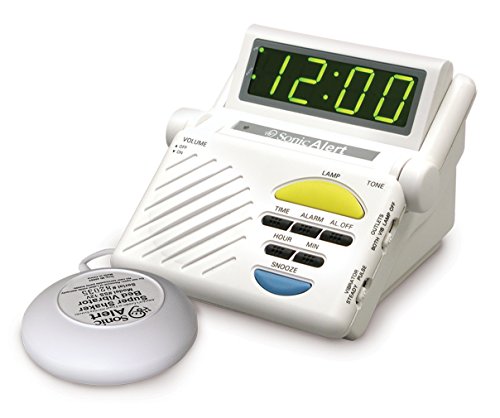
Some people sleep through ordinary alarms, and some cannot hear them at all. The Sonic Boom is built for both groups. Its alarm reaches 113 decibels, with adjustable tone and volume so it can be dialed back to merely very loud, and it pairs that sound with a bed shaker: a small vibrating unit that slips under a mattress or pillow and physically shakes the sleeper awake.
Flashing lights add a third alert channel, and the clock can also switch on a connected lamp. A built-in receiver works with other Sonic Alert signalers, such as doorbell and telephone alerts, which makes this a sensible hub for a deaf or hard-of-hearing household. A 9V battery, not included, provides backup so the time and alarm settings survive an outage, and the maker covers the clock with a five-year warranty.
Set the volume with some care, because at full output this clock is genuinely startling, and it is a poor choice for a shared room or a thin-walled apartment. Light sleepers should look elsewhere in this guide. But if missed alarms have cost you a shift, a flight, or an exam, this is the most forceful wake-up here by a wide margin.
Peakeep 4-Inch Twin Bell Loud Alarm Clock
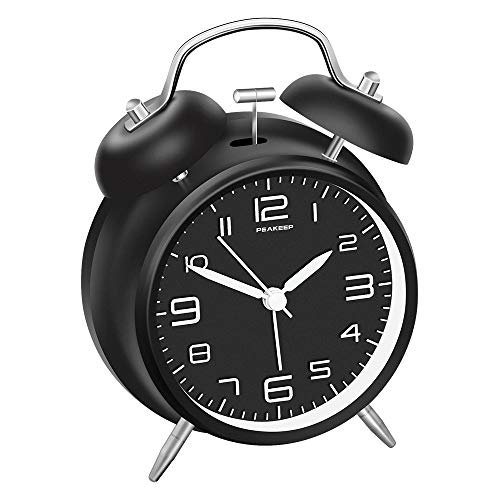
The Peakeep is the analog answer: a metal-cased clock with two bells on top and a small hammer between them. When the alarm time arrives, the hammer strikes both bells in the classic ringing pattern that generations of sleepers learned to respect. It is properly loud, and because the mechanism is simple, there is nothing to configure and nothing to update.
It runs on a single AA battery, so a power cut is irrelevant and the clock can move between a desk, a nightstand, and a guest room without hunting for an outlet. The raised three-dimensional numerals are easy to read at a glance, and pressing the button on top lights the dial briefly for checking the time at night. The alarm is set with a dedicated hand and a knob on the back, the way twin bells have always worked.
The honest drawback is the lack of a snooze function: the bell rings until you switch it off, which is either a flaw or the entire point, depending on your discipline. There is also no date, no temperature, and no gradual anything. As a phone-free, screen-free way to wake up, though, it earns its place on a nightstand.
Marathon Atomic Travel Alarm Clock, CL030036
The Marathon keeps itself right. It receives the WWVB radio signal broadcast from Colorado and corrects its time and date automatically, including daylight saving changes, so the clock stays accurate without ever being set by hand. Six North American time zones can be selected, which suits anyone who travels for work and wants a clock that keeps up.
The display shows the time, the date, and the indoor temperature, with menu language options for English, French, Spanish, German, and Italian. A built-in light sensor switches on a soft amber night light when the room goes dark, bright enough to read the time by and dim enough to sleep through. The case is compact and folds flat, so the same clock can live on a desk all week and go into a bag on Friday.
It runs on AAA batteries, so outages do not affect it at all. The one real limitation is geography: the atomic signal covers North America, and outside that range the clock works as an ordinary manual-set digital. Within range, it is the most set-and-forget clock in this guide.
How to choose
Start with how you actually wake. If noise startles you into a bad mood, a sunrise light solves the problem at the source. If you sleep through beeps, look for volume headroom and a vibrating shaker rather than a slightly louder version of a normal clock. Analog bells sit in between: loud and insistent, with no electronics to fail.
Next, check the power arrangement. Corded clocks need an outlet within reach and should have battery backup so the alarm survives an outage. Battery-only models like the Peakeep and the Marathon ignore outages entirely. Then look at the display. A dimmer with a true low setting matters if the clock shares a room with your bed, and large digits matter if you read the time without glasses.
Finally, count the alarms you need. A single-alarm clock suits a fixed routine, but shift workers and early risers with different weekend hours should look for a dual-alarm model instead. Keep a dedicated smoke alarm in place as well: an alarm clock is not a fire alarm, and the two jobs should never be confused.
Who should skip
Skip the Sonic Boom if you share a room or have thin walls; its full-volume alarm will wake the whole household, not just you. Skip the twin bell if you depend on a snooze button, because it does not have one. Skip the atomic Marathon if you live outside North America, where its self-setting signal does not reach. And if you need two different wake times on different days, none of these single-alarm clocks fits: look for a dual-alarm model with weekday and weekend settings instead.
FAQ
Will my alarm still go off during a power outage?
It depends on the clock. The DreamSky uses battery backup to preserve its settings and sound the alarm while the power is out. The Peakeep and the Marathon run on batteries full time, so an outage changes nothing for them. A mains-only clock with no backup simply goes dark, which is why backup belongs on the checklist before you buy.
Are sunrise wake-up lights a good choice for heavy sleepers?
Usually not on their own. Gradual light works best for people who wake easily but hate abrupt noise, and for dark winter mornings. Genuinely heavy sleepers, and anyone who sleeps facing away from the lamp, tend to need sound or vibration as the main event. The Sonic Boom and its bed shaker are the more reliable answer for that group.
How loud does an alarm clock need to be?
A typical digital alarm is loud enough for an average sleeper in a quiet room. Heavy sleepers should look for an alarm with adjustable volume that goes well beyond standard, plus a backup method such as a bed shaker, because a single very loud tone can still be slept through. Keep extra-loud alarms pointed away from your ears at close range.
Do atomic clocks set themselves anywhere in the world?
No. The Marathon syncs to the WWVB signal from Colorado, which covers North America. Inside that range it sets itself, handles daylight saving changes, and stays accurate without any input from you. Outside the range it still works as a normal digital clock and travel alarm, but the time is set by hand like any other model.
Final verdict
For a straightforward alarm clock that asks almost nothing of you, buy the DreamSky Auto Set: accurate time, automatic daylight saving adjustment, a clear display, and backup power. Choose the Philips Wake-Up Light if mornings feel like an ambush and you would rather surface gradually. Choose the Sonic Boom if alarms routinely fail to wake you, the Peakeep if you want a screen-free ring you cannot ignore, and the Marathon if perfect timekeeping with zero setup appeals most.
Product and ASIN Reference
| Product | ASIN |
|---|---|
| Philips SmartSleep Wake-Up Light, HF3520/60 | B0093162RM |
| DreamSky Auto Set Digital Alarm Clock with Battery Backup | B07G34JD32 |
| Sonic Alert SB1000SS Sonic Boom Alarm Clock | B000EX9K40 |
| Peakeep 4-Inch Twin Bell Loud Alarm Clock | B00ZQG30AK |
| Marathon Atomic Travel Alarm Clock, CL030036 | B017BPJAGQ |
More from Amazon
Programs that pair well with the guide above. Offers and eligibility are set by Amazon and may change.
Set up recurring deliveries of everyday items on eligible products. Terms and savings are set by Amazon.
Explore Subscribe & SaveFree shipping on eligible items, Prime Video and more. Eligible new members can start with a free trial.
Start a Prime free trialA Prime membership for ages 18-24 with a trial period. Eligibility is set by Amazon.
See Prime for Young AdultsAudiobooks and podcasts to listen to on the go. Eligible new members can start with a free trial.
Try Audible freeAs an Amazon Associate we earn from qualifying purchases.







Write Your Review
No reviews yet. Be the first to share your experience!