

Key takeaways
- Compare the best chairs for writers, with adjustable seat depth, supportive arms, quiet casters and tilt locks for long drafting sessions at the desk.
Writing is a strange kind of desk work. A drafting session can mean hours of near-stillness, fingers moving while everything else stays put, followed by a long lean back to stare at a paragraph and think. The best chairs for writers serve both halves of that rhythm: steady, close-in support while the words flow, and an easy recline when the work turns from typing to thinking. A chair that does only one of those jobs well will annoy you by chapter two.
This guide compares five desk chairs that suit long writing sessions in different ways, from a contract-grade task chair with a sliding seat pan to a compact flip-arm chair that disappears under a small desk. Each section covers what matters most to writers: seat depth, arm height, tilt behavior, caster noise, and how the materials feel across a long sit.
As an Amazon Associate, we earn from qualifying purchases.
How to Choose a Chair for Writing
Start with seat depth
Seat depth decides whether you can sit back against the backrest with your feet flat and a small gap behind your knees. A pan that is too deep pushes you into a perch on the front edge; one that is too shallow leaves your thighs unsupported. A sliding seat pan is the simplest fix because it lets you dial the depth to your legs. With a fixed seat, compare its depth with a chair you already sit in comfortably.
Arm height matters more than arm padding
When you type, your forearms should rest roughly level with the keyboard tray or desk surface, elbows close to your body. Armrests set too high shrug your shoulders up; set too low, they might as well not exist. Height-adjustable arms are the minimum worth having. Arms that also adjust in width and depth help you pull close without banging the desktop edge, and flip-up arms are handy in tight nooks where the chair must tuck under the desk.
Tilt lock is a thinking tool
Drafting happens upright or slightly forward; editing often happens leaned back with the document at reading distance. A tilt lock with more than one recline position lets you park the chair at the angle that matches the task, and a tension control keeps the recline from feeling rigid or floppy. Synchro-tilt mechanisms, which move the backrest faster than the seat, keep your feet grounded as you lean back.
Quiet casters for night writing
Many writers work early mornings or late nights in shared homes, and hard plastic casters on wood or tile announce every shift in position. Polyurethane-coated or rubberized wheels roll more quietly and are gentler on flooring. On carpet, standard casters are fine. Check the caster type in the listing before ordering.
Mesh back or cushioned seat
A mesh back breathes, which helps in warm rooms and during summer drafting marathons, and it keeps its shape for years. A cushioned seat feels softer at first sit. Neither is automatically better; the question is how the chair feels at hour three, not minute three. Dense foam holds up longer than thin padding, and a mesh or suspended back removes the foam question for the backrest.
Check the manufacturer’s weight capacity
Every chair here lists a manufacturer-rated weight capacity. Treat it as a build-quality signal as much as a fit limit: higher-rated chairs generally use sturdier frames, cylinders, and bases. Choose one with comfortable headroom above your weight.
Steelcase Series 1

| Spec | Detail |
|---|---|
| ASIN | B078HFDMKD |
| Back style | 3D Microknit mesh over flexible back frame |
| Seat | Foam cushion with adjustable seat depth |
| Arms | 4D adjustable (height, width, depth, pivot) |
| Tilt | Weight-activated recline with boost setting and upright stop |
| Seat height range | 16.5 to 21.5 inches |
| Manufacturer weight capacity | 400 lb |
The Series 1 is the chair on this list built most clearly around seat-depth adjustment. Its sliding seat pan moves through a useful range, so shorter writers can pull the seat in and taller writers can extend it, while the height-adjustable lumbar support stays where it belongs. The weight-activated tilt is a quiet advantage for drafting: the chair reads your body weight and sets recline resistance automatically, so leaning back for a thinking pause takes no knob-twiddling, and the boost setting adds resistance when you want a firmer lean.
The 4D arms are the other writer-friendly detail. They slide forward and back as well as up, down, and sideways, making it simple to set your forearms level with the desk while the chair stays pulled in close. The 3D Microknit back flexes as you shift, so small posture changes during a long scene never feel like a fight.
This is the pick for writers who share a chair with other people, because nearly everything adjusts without tools. It is also the strongest long-term buy here, rated up to 400 lb and built as a multi-shift task chair. Note that this configuration has no headrest.
Herman Miller Sayl

| Spec | Detail |
|---|---|
| ASIN | B00OBWBSA4 |
| Back style | Frameless suspension back (elastomer) |
| Seat | Upholstered cushion, fixed depth on this configuration |
| Arms | Fixed arms on this configuration |
| Tilt | Tilt limiter with seat angle adjustment |
| Manufacturer weight capacity | 350 lb |
The Sayl takes a different route from mesh: its back is a frameless sheet of flexible elastomer strands, inspired by suspension bridge design, that stretches and supports at the same time. For writers, the appeal is how naturally it handles the lean-back-and-think half of the job. The back gives as you recline, holds you without hard frame edges near your shoulder blades, and springs back when you sit up to type. The open structure ventilates well in warm rooms.
The tilt limiter lets you set how far the chair can recline, useful if a full recline would bump into a wall or bookshelf. This configuration pairs it with fixed arms and a fixed seat depth, so it suits writers whose desk height already matches the arm height, or who prefer arms that never drift mid-session.
Choose the Sayl if your writing involves a lot of reclined reading and thinking between typing bursts. Writers who change arm position often, or share the chair with a differently sized partner, will get more from the fully adjustable picks here.
HON Ignition 2.0 Mid Back
| Spec | Detail |
|---|---|
| ASIN | B06Y3PGPR2 |
| Back style | Breathable mesh mid-back |
| Seat | Upholstered cushion |
| Arms | Height and width adjustable |
| Tilt | Advanced synchro-tilt control with tension adjustment |
| Lumbar | Adjustable lumbar support |
| Manufacturer weight capacity | 300 lb |
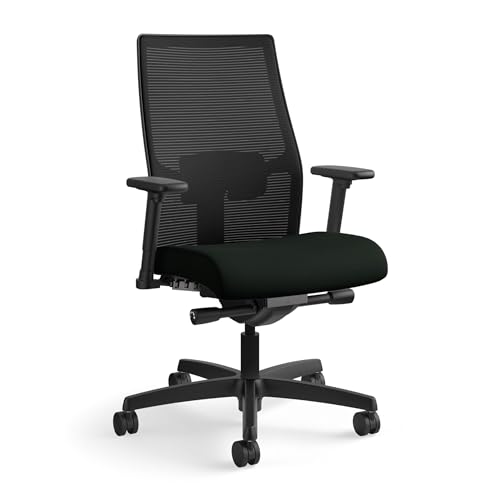
The Ignition 2.0 is a workhorse task chair from a contract furniture maker, and its synchro-tilt is the feature writers should notice first. The backrest reclines faster than the seat, so when you lean back to reread a page, the seat stays relatively level and your feet stay planted. A tension control sets how much push the recline needs, and the tilt locks when you want a fixed reading angle.
Arm adjustment covers height and width, the two changes writers make most: raising the arms to meet a higher desk and narrowing them to slide close. The adjustable lumbar support moves to meet the curve of your back, and the mesh mid-back keeps air moving through long sessions. Its height also suits writers who find tall backs and headrests get in the way when turning to reach a printer or shelf.
Pick the Ignition 2.0 if you want manual, predictable controls rather than automatic ones: every adjustment is a lever or knob you set once and it stays. HON rates this configuration up to 300 lb, and its plain styling fits a spare-room writing office that doubles as a guest room.
SIHOO M18

| Spec | Detail |
|---|---|
| ASIN | B07GNDDNMW |
| Back style | High-back breathable mesh |
| Seat | Cushioned seat, about 17.9 inches deep |
| Arms | 2D adjustable (height and angle) |
| Tilt | Tilt lock with three recline positions (about 108, 118, and 128 degrees) |
| Extras | Adjustable headrest and adjustable lumbar support |
| Seat height range | About 17.3 to 21.3 inches |
| Manufacturer weight capacity | 330 lb |
The M18 is the most feature-dense chair in this roundup. It combines a high mesh back with an adjustable headrest, an adjustable lumbar pad, and a three-position tilt lock, giving writers a clear menu: upright for drafting, mid-recline for editing, full recline for reading a printed chapter. The headrest is a genuine plus for the reading position during long thinking pauses.
The seat is a wide cushion with a waterfall-style front edge, and its depth of roughly 18 inches suits average to taller writers best; shorter writers should check that measurement, because the M18 has no sliding seat pan. The 2D arms adjust for height and angle, enough to level your forearms with most desks.
Shortlist the M18 if you want the headrest-and-tilt-lock combination and a 330 lb rating without stepping into contract-brand territory. Writers with hard floors may want softer wheels, since the standard casters are basic hard plastic.
Hbada J1

| Spec | Detail |
|---|---|
| ASIN | B07QLWTLLN |
| Back style | S-shaped mesh backrest |
| Seat | Molded saddle-style cushion |
| Arms | Flip-up armrests |
| Tilt | Rocking function with swivel |
| Frame | Compact footprint for small desks |
The Hbada J1 is built for the writing corner rather than the writing office. Its defining feature is the flip-up armrests: raise them and the chair slides fully under most desks, freeing floor space in a bedroom or studio apartment between sessions. Lower them and you have arm support for typing. The trade-off is fixed arm height, so check that your desk height and the arm height are compatible before choosing it.
The molded saddle cushion spreads your weight across a wider surface, and the S-shaped mesh back follows the curve of your spine in a general way, with airflow that helps on summer writing days. The chair has a gentle rocking function for thinking breaks, though it does not lock at multiple angles like the SIHOO and HON above.
Choose the J1 if space is your binding constraint: a dorm-style desk, a closet office, or a shared room where the chair must disappear when work ends. Writers planning daily six-hour sessions will be better served by a fully adjustable chair earlier in this guide, but for a compact setup and a few focused hours a day, it covers the essentials.
Frequently Asked Questions
How much seat depth adjustment does a writer actually need?
Enough to sit fully back with a gap of two or three fingers between the seat edge and your knees. If your legs are shorter or longer than average, a sliding seat pan is the safest route; with a fixed seat, compare the listed depth with a chair you find comfortable.
Are flip-up arms a good idea for a writing chair?
They are a good idea when space matters more than fine adjustment. Flip-up arms let the chair tuck under the desk and give you an armless option for sitting cross-legged or sideways. The compromise is fixed arm height, so they suit writers whose desk height happens to match.
Mesh or cushion: which lasts longer through daily writing?
Both can last for years, but they age differently. Mesh backs keep their shape and airflow and do not compress. Seat foam slowly softens with daily use, and denser foam softens more slowly. If you write full-time, a mesh back paired with a well-made cushion, or a suspension back like the Sayl’s, spreads the wear across both materials.
What caster type is quietest for night writing sessions?
Polyurethane-coated or rubberized wheels are the quietest on hard floors, since the soft coating absorbs the rumble hard plastic casters produce on wood and tile. On carpet, standard casters are quiet enough. Many chairs accept replacement wheels, so caster noise is easy to fix after purchase.
Product and ASIN Reference
| Product | ASIN |
|---|---|
| Steelcase Series 1 | B078HFDMKD |
| Herman Miller Sayl | B00OBWBSA4 |
| HON Ignition 2.0 Mid Back | B06Y3PGPR2 |
| SIHOO M18 | B07GNDDNMW |
| Hbada J1 | B07QLWTLLN |
More from Amazon
Programs that pair well with the guide above. Offers and eligibility are set by Amazon and may change.
Set up recurring deliveries of everyday items on eligible products. Terms and savings are set by Amazon.
Explore Subscribe & SaveFree shipping on eligible items, Prime Video and more. Eligible new members can start with a free trial.
Start a Prime free trialA Prime membership for ages 18-24 with a trial period. Eligibility is set by Amazon.
See Prime for Young AdultsAudiobooks and podcasts to listen to on the go. Eligible new members can start with a free trial.
Try Audible freeAs an Amazon Associate we earn from qualifying purchases.


Write Your Review
No reviews yet. Be the first to share your experience!