

Key takeaways
- Tall shoppers need seat height, depth, and back height that fit longer legs and torsos. These five office chairs are sized for taller frames and long days.
- Top Pick: Secretlab Titan Evo XL Stealth Gaming Chair
- Runner-up: Steelcase Leap Office Chair
- Also consider: HON Ignition 2.0 Big and Tall Office Chair
Standard office chairs are drawn around an average frame, and tall shoppers feel every shortcut. A seat that stops too low leaves knees riding higher than hips, a shallow cushion cuts off thigh support, and a short backrest puts the headrest somewhere around the shoulder blades. The fix is not a chair labeled tall by marketing alone. It is a chair whose seat-height range, seat depth, and backrest height actually match longer legs and a longer torso, with enough adjustment to fine-tune the fit at a real desk.
As an Amazon Associate, we earn from qualifying purchases.
Quick answer
For tall people, fit comes from three measurements: a seat that rises high enough to level the knees, enough seat depth to support long thighs, and a backrest tall enough to reach the head. The Secretlab Titan Evo XL and the HON Ignition 2.0 Big and Tall cover the tallest frames, while the Steelcase Leap wins on adjustment range.
Secretlab Titan Evo XL Stealth Gaming Chair

The Titan Evo XL is the rare chair genuinely drawn for very tall frames, with brand fit guidance reaching up to 6 feet 9 inches. The XL size pairs a wide, deep seat with a tall backrest, so the headrest lands behind the head instead of digging into the shoulders. Cold-cure foam keeps the cushion firm and supportive rather than pillowy, which suits heavier, taller sitters during long sessions.
A four-way adjustable lumbar support sits inside the backrest and moves up, down, in, and out, letting tall users place the curve exactly where their lower back needs it. The magnetic memory-foam headrest pillow attaches without straps and can be removed in seconds. Full-length 4D armrests adjust in four directions, and the multi-tilt base locks at working and reclined angles.
The gaming styling will not suit every office, and the firm seat takes a short break-in period. For tall shoppers who have never had a headrest reach them before, this is the benchmark pick. The XL frame’s proportions also suit tall users who split time between desk work and gaming, and the chair’s weight rating gives heavier sitters headroom that standard gaming chairs rarely match. Armrest width adjustment helps broad shoulders rest naturally instead of squeezed inward.
Steelcase Leap Office Chair

The Leap is not sold as a tall chair, yet its adjustment range quietly makes it one of the best fits for taller bodies. The seat depth slides forward to support long femurs, and the seat-height range pairs with a backrest that follows the spine as it changes shape through the day. Steelcase calls the system LiveBack, and it keeps contact along the whole back instead of only at the shoulders.
Upper and lower back firmness adjust independently, which helps tall users who need strong lumbar pressure without pushing the shoulder blades forward. The arms move in height, width, depth, and angle, so long arms can rest naturally at desk height. A natural glide system shifts the seat as you recline, keeping you closer to the desk and monitor.
The backrest is shorter than the Titan Evo XL, so shoppers well above 6 feet 4 inches should check the headrest-free fit carefully. Everyone else gets one of the most adaptable chairs sold. The waterfall seat edge reduces pressure behind the knees, a detail long-legged users notice by the end of a workday. It is also one of the easier premium chairs to find in several upholstery options, and strong parts availability makes it a long-term purchase rather than a disposable one.
HON Ignition 2.0 Big and Tall Office Chair

HON built this version of the Ignition 2.0 specifically for larger and taller sitters, with a 450-pound capacity rating and a seat that rises to about 22.25 inches off the floor. That extra lift matters: it lets long legs settle with feet flat and knees near level instead of jacked up by a short cylinder. The seat cushion is wide and deep, and the mesh back is tall enough to support a long torso.
Synchro-tilt recline moves the back and seat in a coordinated ratio, and the controls cover seat height, seat depth, arm height and width, and tilt tension. The breathable mesh keeps air moving during long shifts, and the upholstered seat softens the sitting surface without swallowing support.
It looks like straightforward office furniture rather than a statement piece, and the arms are functional rather than plush. As a work-first chair sized honestly for tall frames, it is hard to fault. The controls sit within easy reach under the seat, and assembly is a manageable job. For tall users who have broken standard chairs before, the reinforced frame and honest capacity rating are the real selling points here, beyond any single comfort feature.
HON Ignition 2.0 Mid-Back Task Chair
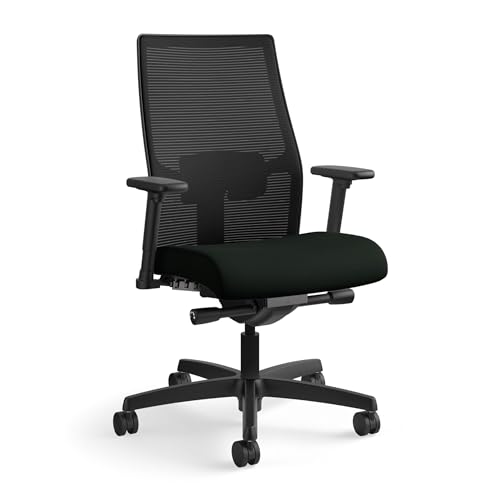
The standard Ignition 2.0 Mid-Back earns its place here through one feature tall shoppers should always hunt for: sliding seat depth. Moving the cushion forward gives long thighs full support and stops the front edge from pressing into the back of the knees, the most common complaint tall people have about mid-priced task chairs.
An adjustable lumbar support moves to meet the lower back, the mesh back flexes with posture changes, and synchro-tilt recline keeps feet planted while leaning back. Height-adjustable arms and a solid height range round out a chair that adapts to a wide band of taller users, especially those between about 5 feet 10 inches and 6 feet 3 inches.
The honest limit is the mid-back height. Very tall torsos will find the top of the backrest ending below the shoulder blades, with no headrest option. Treat it as the pick for moderately tall shoppers who value seat-depth adjustment over backrest height. Tall users pairing it with a height-adjustable desk will get the most from the seat-depth slide, since the desk can rise to meet the chair instead of forcing the chair to do all the adapting alone.
Duramont Ergonomic Office Chair
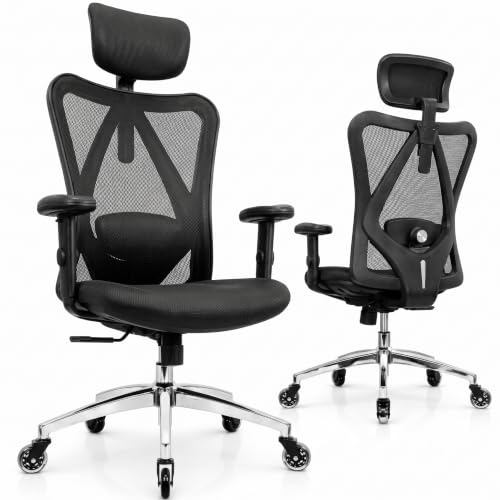
The Duramont is the adjustment-heavy value pick of this group, and tall shoppers benefit from how much of the chair moves. The lumbar support adjusts in height and depth, the headrest adjusts in height and angle, the armrests lift, and the seat height range works for longer legs. A separate lever locks the recline at any angle rather than only upright or fully back.
The breathable mesh back keeps the chair cool, and the thick seat cushion uses dense foam that holds its shape under bigger frames, with a stated capacity around 330 pounds. Rollerblade-style wheels roll quietly and suit hard floors.
Fit caveats: the backrest is not the tallest here, and the seat depth does not slide, so extremely long thighs get less fine-tuning than on the Steelcase or HON chairs. For tall buyers who want headrest and lumbar adjustment without moving into premium territory, it covers the essentials well. The tilt tension also adjusts, so heavier users do not feel the backrest pushing them forward, and the recline range leans back far enough for genuine breaks between tasks.
How to choose
Start with your popliteal height, the distance from the floor to the crease behind your knee while wearing work shoes. Your chair’s lowest useful seat height should sit at or just below that number, and its maximum should reach it comfortably; tall shoppers often need a range topping out near 21 or 22 inches. Next, seat depth: sit against the backrest and look for two or three fingers of clearance behind the knee. Fixed shallow seats fail long thighs, so favor depths near 20 inches or a sliding seat. Backrest height matters just as much; the top should reach at least the shoulder blades, and a headrest only counts if it actually meets your head. Finally, check the cylinder and base ratings against your weight, and confirm the raised seat still lets your thighs clear the underside of your desk.
Who should skip
Average-height and petite shoppers should skip most of this list. Deep seats and high minimum heights leave shorter legs dangling, which causes its own circulation and posture problems; a standard or petite chair will fit better. Anyone who needs a headrest for naps rather than work posture should also look at recliners instead. And if your desk has a low modesty panel or drawer unit, measure first, because a chair raised for long legs may no longer slide underneath.
Frequently Asked Questions
What seat height should a tall person look for?
Most tall shoppers do best with a seat that adjusts up to at least 21 inches from the floor. That height lets long legs rest with feet flat and knees roughly level with the hips. If your popliteal measurement is higher, look for big-and-tall models whose range reaches 22 inches or more, and confirm the desk still clears your thighs.
At what height do standard office chairs stop fitting?
Problems usually start around 6 feet 2 inches, though proportions matter more than the number. Long legs outgrow standard seat depth first, then a long torso outgrows backrest height. If your knees sit well above your hips at maximum seat height, or the headrest touches your shoulders, the chair is too small regardless of its label.
Are gaming chairs a good option for tall people?
Some are, because gaming lines often include XL sizes with taller backrests and integrated headrests. The Secretlab Titan Evo XL is a good example of a gaming chair drawn for genuinely tall frames. The catch is styling and firmness: gaming seats tend to be firmer and more bolstered, which not every office worker wants for daily desk work.
Can I just fit a longer gas cylinder to my current chair?
Sometimes, and it can raise a chair that is otherwise deep and tall enough. The risk is stability and fit: a longer cylinder changes the chair’s geometry, may void coverage, and does nothing for a shallow seat or short backrest. Measure the seat depth and backrest first. If those fall short too, replacing the chair is the better fix.
Final verdict
Tall shoppers should buy by measurement, not by label. The Secretlab Titan Evo XL and HON Ignition 2.0 Big and Tall fit the tallest frames outright, the Steelcase Leap adapts to the widest range of tall proportions, the Ignition 2.0 Mid-Back serves moderately tall users who need seat-depth adjustment, and the Duramont covers headrest and lumbar tuning on a tighter budget.
More from Amazon
Programs that pair well with the guide above. Offers and eligibility are set by Amazon and may change.
Set up recurring deliveries of everyday items on eligible products. Terms and savings are set by Amazon.
Explore Subscribe & SaveFree shipping on eligible items, Prime Video and more. Eligible new members can start with a free trial.
Start a Prime free trialA Prime membership for ages 18-24 with a trial period. Eligibility is set by Amazon.
See Prime for Young AdultsAudiobooks and podcasts to listen to on the go. Eligible new members can start with a free trial.
Try Audible freeAs an Amazon Associate we earn from qualifying purchases.


Write Your Review
No reviews yet. Be the first to share your experience!