

Key takeaways
- Compare the best transfer boards for wheelchair, bed and car moves: wooden slide boards and a rotating-seat pick, sized by length, width and load rating.
A transfer board bridges the gap between two seats so a person with limited leg strength can slide across instead of being lifted. The right board depends on the distance it has to span, the weight it must carry, and whether the rider slides on a fixed surface or rides a moving seat. The five boards below cover the main shapes of that job: standard and heavy-duty wooden boards, a light board for tight spaces, a flexible plastic board, and a rotating-seat design that does the turning for you.
As an Amazon Associate, we earn from qualifying purchases.
Quick answer
For most wheelchair-to-bed moves, the 30-inch DMI board pairs a 440-pound rating with two cutout handles and a sealed pine surface. Heavier riders should look at the wider DMI rated to 735 pounds. The suboton suits riders who cannot scoot, since its turntable carries them across, while the short Vive board fits tight bathroom gaps and the SafetySure plastic board is the light, wipe-clean option.
DMI Transfer Board and Slide Board, 30 x 8 x 1

The DMI board is the standard wooden slide board that home-care suppliers have sold for years. It is cut from Scotch pine at 30 inches long, 8 inches wide and a full inch thick, and it is rated to hold up to 440 pounds. Two cutout handles are built in, giving a caregiver a firm grip when sliding one end under the rider and a way to hold the board steady during the transfer. Length is the point here. Thirty inches spans the wider gaps that defeat shorter boards, such as a wheelchair to a bed with a frame rail, or a car seat set back from the door sill. The trade-offs are the ones common to plain wooden boards. The rider does the work, scooting in stages, and the caregiver must guard against the board shifting on smooth seats. Listing crawls gave mixed offer signals, with one showing the board in stock and sold by Amazon and others showing no featured offers, so confirm a live offer before ordering. Choose this one for daily bed and chair transfers, if the rider has the arm strength to scoot with some help.
Vive Transfer Board, 24 x 8 x 0.75
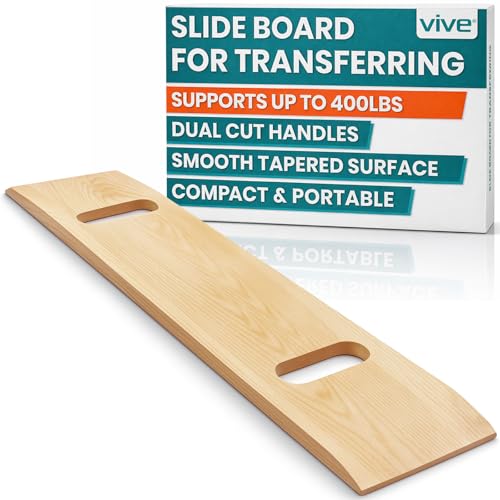
The Vive board, model RHB1037WOOD, takes the opposite approach to the DMI: shorter and slimmer for the transfers where space, not span, is the problem. It measures 24 inches long, 8 inches wide and three quarters of an inch thick, and it weighs only 2 pounds, so it is easy to lift and reposition dozens of times a day. The listing describes it for moves between a wheelchair and a bed, toilet, car or bathtub. Vive builds it from sealed lightweight wood with a slick surface, so clothing slides rather than catching, and the sealed finish wipes clean after bathroom use. Two gaps are worth knowing. The listing data shown does not state a weight capacity for this 24-inch size, so treat it as the light-duty pick and confirm the figure before relying on it for a heavier rider. One listing crawl also showed no featured offers available, so check for a live offer first. The limit is reach. Twenty-four inches needs the two seats nearly touching, with real overlap at both ends, so it is the wrong pick for a wide bed gap or a deep car seat.
DMI Transfer Board and Slide Board, 32 x 10 x 1, 735 lb

The second DMI board answers the question the first one cannot: what carries a heavier rider across a wider seat? This version is built from heavy-duty wood at 32 inches long, 10 inches wide and one inch thick, and the listing rates it to hold up to 735 pounds, the highest rating in this roundup. Two cutout handles are built in, as on the smaller board, and it is both FSA and HSA eligible. The extra two inches of width are as important as the rating. A wider deck gives a larger rider more support under the hips mid-slide, where a narrow board can feel unstable, and leaves more board resting on each seat. Size cuts both ways. A bigger board takes more effort to position, and it will not fit the tight toilet and tub gaps where the 24-inch Vive works. One listing crawl showed no featured offers available, so confirm a live offer before ordering. Choose this one when the rider’s weight rules out the 440-pound boards, or when a wide, stable platform matters more than easy handling.
SafetySure Plastic Transfer Board, 30 Inch

The SafetySure is the only plastic board in this group, and that changes how it behaves. It is made of semi-rigid polyethylene, 30 inches long, 12.5 inches wide and a quarter of an inch thick, and it weighs 3 pounds. Two built-in hand slots make it easy to place and remove, and they double as a way to hang the board up when it is not in use. The plastic wipes down between uses, which suits bathroom and commode transfers where a wooden board would need more care. The trade-off is capacity: the listing rates it to 250 pounds, the lowest in this roundup, and semi-rigid plastic flexes more under load than an inch of pine. That makes it the wrong pick for heavier riders, but a sensible one for a lighter rider who values a board that is easy to clean and easy to carry. The 12.5-inch width is the broadest deck here, which gives more surface under the hips even though the board itself is thin. Choose the SafetySure when the rider is well inside its 250-pound rating, when wipe-clean plastic matters more than maximum load, and when a light board that hangs on a hook between uses is what the bathroom needs.
suboton Slide Transfer Board with Turntable

The suboton board takes the rotating-seat idea and puts it on a wooden deck. A 360-degree rotating turntable rides in a sliding groove along the board, so the rider sits on the turntable, glides across on it, and can rotate at the far end to face the right way off the board. The board is made of rubberwood and the listing rates it to 450 pounds, and it is FSA eligible. The maker describes it for transfers between a wheelchair and a bed, toilet, sofa or car. That combination covers a common middle case: a rider who can sit and hold on but cannot manage the scooting motion on a plain board, doing the everyday bed, chair and toilet moves rather than a long reach into a car. The turntable removes most of the skin and clothing drag of a fixed surface, and the rotation at the end replaces the shuffle needed to square up on the new seat. One listing crawl showed no featured offers available, so check for a live offer first. Choose it if assisted home transfers feel like hard work on a plain board.
How to choose
Start with the gap. A board has to rest securely on both seats at once, so measure the widest space you cross regularly and pick a length that leaves solid overlap at both ends. A 24-inch board only works where the seats sit close together, while car transfers and deep beds usually call for 30 inches or more. Next, match the two seat heights as closely as you can: a board laid on a slope slides the rider downhill, and a steep angle makes the return trip hard work. Check the weight rating against the rider, not the caregiver, and leave margin rather than buying right at the limit. Then decide how the slide should happen. On a plain board the rider scoots across a fixed surface in small moves, which asks for arm strength and can drag on skin and clothing. On safety, no CPSC recall covers transfer boards as a product class, and none of the five models in this guide is under a recall. A board is a bridge, not a lift, so it only suits someone who can sit upright and bear weight through their arms, ideally with training from a therapist first.
Who should skip
Skip transfer boards if the rider cannot sit upright unsupported or cannot bear weight through the arms, since a board offers no lifting help and no back support. In that case a patient lift is the right class of product, not a longer board. Skip them as well if the gap between the seats is wider than the longest board here can span with overlap at both ends, or if the two seats sit at very different heights, since a board on a steep slope is unsafe in both directions. Riders with fragile skin should skip plain wooden boards and use a rotating-seat design instead, because scooting drags skin across a fixed surface. Finally, skip this guide if the transfer is between a wheelchair and a shower or tub with water involved, where a shower chair and grab bars are the safer setup.
FAQ
How long should a transfer board be?
Measure the gap between the two seats, then add enough length for the board to rest firmly on both. A 24-inch board suits gaps of only a few inches, such as a wheelchair pulled tight against a toilet. Most bed and car transfers need 30 inches or more, and the board should overlap each seat by several inches at both ends,
Can one person use a transfer board alone?
It depends on arm strength and sitting balance. A rider with strong arms and steady balance can slide independently on a plain board, and a rotating-seat board makes that easier. Ask a therapist to watch a transfer before doing it alone, since a board gives no help if balance fails mid-slide.
Wood or plastic transfer board?
Wood is rigid and carries more weight: the DMI boards here are rated to 440 and 735 pounds. Plastic is lighter and wipes clean, but it flexes under load and the SafetySure here is rated to 250 pounds. Choose wood when capacity and stiffness matter, and plastic when the board lives in a bathroom, gets cleaned often, and the rider is well inside its rating.
How do I keep a transfer board from sliding?
Set the board so it overlaps both seats by several inches, level the seat heights as closely as you can, and keep the underside clean and dry. Never use a board on a slope, and replace a board whose surface has worn rough or whose handles have cracked, since both failures happen mid-transfer.
Final verdict
For most wheelchair-to-bed moves, the 30-inch DMI board is the right starting point: a proven sealed pine board rated to 440 pounds with two cutout handles. Buy the wider DMI when the rider needs its 735-pound rating, and the suboton when scooting is too hard and a turntable should do the work. The Vive 24-inch board covers tight bathroom gaps, and the SafetySure plastic board is the light, wipe-clean choice for lighter riders.
Product and ASIN Reference
| Product | ASIN |
|---|---|
| DMI Transfer Board and Slide Board, 30 x 8 x 1 | B000WNJU1A |
| Vive Transfer Board, 24 x 8 x 0.75 | B0G76XJ96N |
| DMI Transfer Board and Slide Board, 32 x 10 x 1, 735 lb | B00DM35ONU |
| SafetySure Plastic Transfer Board, 30 Inch | B00XBMC5CA |
| suboton Slide Transfer Board with Turntable | B0F48418VY |
More from Amazon
Programs that pair well with the guide above. Offers and eligibility are set by Amazon and may change.
Set up recurring deliveries of everyday items on eligible products. Terms and savings are set by Amazon.
Explore Subscribe & SaveFree shipping on eligible items, Prime Video and more. Eligible new members can start with a free trial.
Start a Prime free trialA Prime membership for ages 18-24 with a trial period. Eligibility is set by Amazon.
See Prime for Young AdultsAudiobooks and podcasts to listen to on the go. Eligible new members can start with a free trial.
Try Audible freeAs an Amazon Associate we earn from qualifying purchases.

Write Your Review
No reviews yet. Be the first to share your experience!