

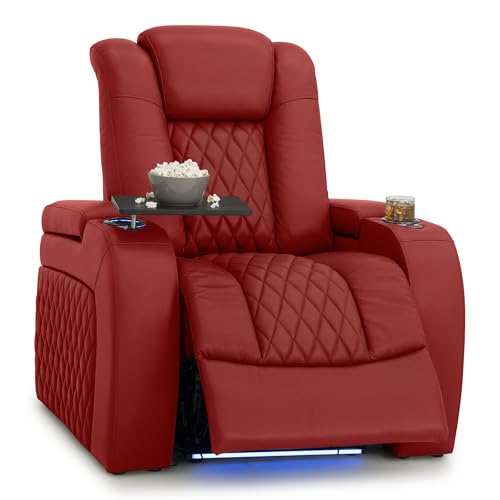
The best home theater recliner for most rooms is the Octane Turbo XL700 for value and tight wall clearance, the Seatcraft Equinox if you want a fully powered headrest and lumbar, and the Valencia Tuscany if leather quality and a luxury finish matter most. Big and tall viewers should look at the Seatcraft Pantheon Big and Tall. Before choosing any of them, measure your room, because recline length, wall clearance, and row width decide more regrets than leather grade does.
Home theater seating is a different category from a living room recliner. The seats are sold singly or in rows, they usually have power recline with a hidden motor, and they include built-in cupholders, lighting, and USB charging. They also need space behind them to recline, and a row of three can be wider than a typical sofa. This guide covers six current models, explains the specs that decide fit, and works through the distance and row calculations most buyers skip.
Our top picks



As an Amazon Associate we earn from qualifying purchases at no extra cost to you.
Quick comparison of the six picks
| Pick | Best for | Wall clearance | Power features | Capacity | Price tier |
|---|---|---|---|---|---|
| Octane Turbo XL700 | Best value row | 4 in | Power recline, manual headrest, LED, USB | Check the maker | Budget to mid-range |
| Seatcraft Equinox | Full power adjustment | 3.5 in | Power recline, headrest, lumbar, USB-A and USB-C | 350 lb | Mid-range |
| Octane Regal XL250 | Tight rooms and custom upholstery | About 4 in | Power recline, USB controller, LED cupholders | Check the maker | Mid-range |
| Seatcraft Diamante | Wall-hugger for small rooms | 2 to 6 in | Powered headrest, USB, tray table | Check the maker | Mid-range |
| Valencia Tuscany | Luxury leather and features | 12 in | Motorized recline, headrest, lumbar, RGB LEDs | 300 lb | Premium |
| Seatcraft Pantheon Big and Tall | Larger viewers | 8 to 12 in | Power recline, headrest, lumbar, LEDs | 400 lb | Premium |
The figures come from manufacturers’ pages, retailer listings, and published buying guides. Dimensions can differ by configuration, such as single seat versus a row with a console, so confirm the exact version you are ordering.
Best value: Octane Turbo XL700
The Octane Turbo XL700 measures about 37.5 inches wide and 36 inches deep per seat and reaches 66 inches fully reclined. Wall clearance is about 4 inches. It uses Italian Luxe top-grain leather, a power recline with unlimited positions, a manual articulated headrest, deep in-arm storage, an accessory dock, ambient blue LED lighting, USB charging, pocketed coils, gel memory foam, and a steel-and-hardwood frame. It is sold as single seats and in straight, curved, or loveseat rows of one to six seats.
The compromise is the manual headrest, which has to be pushed by hand. Custom builds can have lead times of 16 to 20 weeks in some published reports, so order early if you are planning around a move-in date. A three-seat configuration is described as roughly 98 inches wide, which is why you need to measure before ordering.
Who it suits: buyers who want a multi-seat room at a manageable cost.
Pros: low cost per seat, 4-inch clearance, deep arm storage, modular rows.
Cons: manual headrest, long custom lead times, capacity not clearly stated in the guides we reviewed.
Best fully powered: Seatcraft Equinox
The Equinox has a 40-inch footprint and reaches 67.5 inches reclined, needs just 3.5 inches of wall clearance, and is rated for 350 lb. It uses grade 7000 Italian top-grain leather in eight colors, a 2.2-density CoolGel memory foam seat, pocketed coils, seven-color LED cupholders and base, and USB-A and USB-C charging. Power recline, headrest, and lumbar are all motorized. Guides describe it as a triple-power chair.
That power lumbar adjustment is the biggest difference from the Turbo XL700, and it makes a difference in long movies, since you can fine-tune support without leaving the seat. The cost per seat is higher, and a five-seat row adds up quickly.
Who it suits: viewers who watch long films and want full control of headrest and lumbar.
Pros: triple-power adjustment, 350 lb rating, tight wall fit, real leather.
Cons: higher cost per seat than the Octane; wider footprint than some competitors.
Best for tight rooms and custom upholstery: Octane Regal XL250
The Octane Regal XL250 is a wall-hugger power recliner that needs about 4 inches from the wall. A two-arm seat measures about 35.5 x 36.25 x 43 inches, a single-arm seat 29.75 inches wide, and an armless seat 24 inches wide. Straight rows measure 65.25 inches for two seats, 95 for three, 124.75 for four, 154.5 for five, and 184.25 for six, with the same 36.25 inch depth and 43 inch height. A minimum door width of about 25.25 inches is needed for a seat to enter.
Power recline uses the WhisperMax system, run from a control on the inside arm that also has USB ports. Upholstery options include Italian leather, vegan leather, leather gel, and microfiber. Retailers differ on whether a power headrest comes standard, so confirm that before ordering. The warranty is reported as five years on the frame, springs, and recline mechanism, two years on padding and foam, and one year on leather and electrical parts.
Who it suits: narrower rooms, buyers who want a choice of upholstery.
Pros: slim arms and armless options, wedge seats for curved rows, multi-year frame warranty, quick assembly.
Cons: headrest power varies by retailer; capacity not clear in the sources reviewed.
Best compact wall-hugger: Seatcraft Diamante
The Diamante is listed at about 37 x 43 x 37 inches, with a wall clearance of 2 to 6 inches thanks to its wall-hugger design. It uses grade 7000 top-grain leather, a powered headrest, USB charging, and a tray table. It does not list motorized lumbar. Guides note that the seat can slide forward during recline, so it suits rooms where the front row has space.
The strongest argument for the Diamante is a basement or apartment where the seat must sit close to a wall. Pricing information in published guides is dated, so verify at the time of purchase.
Who it suits: smaller rooms with limited depth behind the seat.
Pros: minimal clearance, powered headrest, tray table.
Cons: no power lumbar listed; slides forward on recline.
Best luxury finish: Valencia Tuscany
The Valencia Tuscany uses Nappa 11000 top-grain leather with French diamond stitching, motorized recline, headrest, and lumbar, RGB seven-color LEDs, black-chrome cupholders, Cool Gel memory foam, and USB-A and USB-C charging. The console edition measures about 85.5 x 40 x 43.5 inches. It needs 12 inches of wall clearance, which is the largest requirement here, and is rated at 300 lb. A hands-on review reported an 18W USB-C port charging a MacBook Air to 50 percent during one movie.
The 12 inch clearance and 300 lb rating are the two limits to consider. In a shallow room you may not have the space, and larger viewers should look at the Pantheon. Pricing varies widely by configuration and retailer, with single seats and five-seat rows priced very differently.
Who it suits: dedicated theater rooms with space and a premium budget.
Pros: high-grade leather, full motorized control, strong charging.
Cons: 12 inch clearance, 300 lb rating, premium cost.
Best for larger viewers: Seatcraft Pantheon Big and Tall
The Pantheon Big and Tall has a 26.5 inch seat width, a 400 lb rating, a reinforced heavy-duty frame, grade 7000 Italian top-grain leather, power recline, power headrest, power lumbar, LED cupholders and base, in-arm storage, USB charging, and SoundShaker compatibility. Wall clearance is 8 to 12 inches. It is the most expensive per seat in the group and takes the most room.
For anyone close to or above 300 lb, or very tall, the Pantheon is the sensible option because the other chairs are rated lower. It also pairs well with a mixed row where one seat is Big and Tall.
Who it suits: larger viewers and households with mixed sizes.
Pros: 400 lb rating, wide seat, full power control.
Cons: premium cost, large footprint, needs standard clearance.
How to choose home theater recliners
1. Measure clearance first
Wall-hugger designs need 2 to 4 inches, standard power recliners need 8 to 12 inches. If your seats sit against a back wall, this is the number that matters most.
2. Decide on power features
- Power recline only: simplest and cheapest.
- Power headrest: helps with screen angle and neck support.
- Power lumbar: a luxury that matters in long viewing sessions.
3. Upholstery
Top-grain leather feels better and ages well but costs more. Bonded or vegan leather and microfiber can be more durable for households with pets or small children, and a few makers offer them on the same frames.
4. Capacity and seat width
Standard capacities range from 300 to 350 lb, and big and tall frames go to 400 lb. Seat width ranges from 24 inches for armless seats to over 35 inches for two-arm seats.
5. Row configuration
Straight rows suit rectangular rooms. Curved rows with wedge pieces work in wider rooms. Loveseats can save width but remove individual arms.
Worked example: seat spacing and viewing distance
Suppose your room is 14 feet wide and 20 feet deep, with a 100-inch 16:9 screen on the front wall.
- Screen width. A 100 inch diagonal 16:9 screen is about 87 inches wide.
- Viewing distance. For a 40 degree viewing angle, a common guideline in cinema design, the distance is the screen width divided by twice the tangent of 20 degrees. That is 87 / 0.728, or about 120 inches (10 feet). For a more relaxed 30 degree angle, it is 87 / 0.536, or about 163 inches (13.6 feet). Choose a distance between those figures.
- Row width. A three-seat straight row of Octane Regal XL250 two-arm seats measures about 95 inches wide. In a 14 foot (168 inch) room, that leaves 73 inches, or 36 inches on each side. Four seats at 124.75 inches leave about 43 inches total, which is tight for walking.
- Depth. Measure from the screen to the front of the footrest when the seat is reclined. A seat that reclines to 66 inches (5.5 feet) and sits with its back 14 feet from the screen has its footrest about 8.5 feet from the screen, so the distance you judge for the picture is the footrest-out position, not the upright one. Work out which position you will mostly watch in.
- Back wall and second row. A second row needs its own 66 inches of recline length plus a walkway of about 2 feet between rows. In a 20 foot (240 inch) room, two rows need roughly 66 + 66 + 24 = 156 inches for seating and aisle, leaving 84 inches (7 feet) between the screen wall and the first row. That is shorter than the 10 foot viewing distance above, so in a 20 foot room a two-row layout means a smaller screen, or a deeper room, or a single row.
The figures show why rooms under about 12 feet wide often suit two-seat rows and narrower armless or single-arm seats, while 14 feet and wider can handle three or four.
Power features compared in detail
| Model | Seat footprint | Fully reclined length | Upholstery listed | Warranty detail reported |
|---|---|---|---|---|
| Octane Turbo XL700 | 37.5 x 36 in | 66 in | Italian Luxe top-grain leather | Confirm with the maker |
| Seatcraft Equinox | 40 in wide footprint | 67.5 in | Grade 7000 Italian top-grain leather | Confirm with the maker |
| Octane Regal XL250 | 35.5 x 36.25 x 43 in (two-arm) | Varies by version | Italian leather, vegan leather, leather gel, microfiber | 5 years frame and mechanism, 2 years padding, 1 year leather and electrics |
| Seatcraft Diamante | 37 x 43 x 37 in | Varies by version | Grade 7000 top-grain leather | Confirm with the maker |
| Valencia Tuscany | Console edition 85.5 x 40 x 43.5 in | Needs 12 in wall clearance | Nappa 11000 top-grain leather | Confirm with the maker |
| Seatcraft Pantheon Big and Tall | 26.5 in seat width | Needs 8 to 12 in clearance | Grade 7000 Italian top-grain leather | Confirm with the maker |
Warranty detail was only clearly published for the Regal XL250 in the sources used here, so ask the seller for the written terms on the others, especially on the motor and electronics.
Setup checklist before delivery day
- Map the outlets. Mark where each seat’s power adapter will plug in, and plan a hidden route for cables so nobody trips on them in a dark room.
- Measure the path. A single seat can need a door at least 25 inches wide, and corners with tight turns can stop a seat that is otherwise narrow enough.
- Check the floor. Carpet works well for the first row. On hard floors, add a rug or glides so seats do not slide when they recline.
- Allow for light. LED cupholders and base rails glow in a dark room. Many seats let you switch them off, which helps if the lights distract from the picture.
- Plan the riser. A second row sitting 6 to 12 inches higher than the first improves sight lines over the heads in front.
- Test every function on arrival. Run recline, headrest, lumbar, USB ports, and LEDs on each seat before you accept delivery.
Ownership realities
- Motors: power recline motors and controllers are the most likely parts to need service. Prefer makers with 5-year frame and recline mechanism coverage.
- Leather care: clean with a damp cloth and a leather conditioner a few times a year. Keep chairs away from vents and direct sun.
- Cables: power-recline seats need an outlet and a way to hide the cable. Plan outlets before delivery.
- Delivery: seats can be 100 lb or more. A door width of 25 inches or more is typical for entry.
- Replacement: choose a maker that continues to sell your model so you can add seats later.
Decision matrix
| Your situation | Best match | Reason |
|---|---|---|
| Four-seat row on a budget | Octane Turbo XL700 | Lowest cost per seat, 4 in clearance |
| Long movies | Seatcraft Equinox | Power headrest and lumbar |
| Basement with a back wall | Seatcraft Diamante | 2 to 6 in clearance |
| Dedicated room | Valencia Tuscany | Premium leather, full motor control |
| Larger viewers | Seatcraft Pantheon | 400 lb rating |
| Custom fabric choices | Octane Regal XL250 | Leather, vegan leather, microfiber |
Frequently Asked Questions
How much space do I need behind home theater recliners?
Wall-hugger models need about 2 to 4 inches. Standard power recliners may need 8 to 12 inches, and some luxury seats need 12 inches. Always measure from the wall to the back of the seat when upright.
Is leather or microfiber better?
Top-grain leather feels better and ages well but costs more. Microfiber and bonded leathers can resist wear in homes with pets and kids. Choose based on use rather than on price alone.
How many seats can I fit in a row?
It depends on seat width. Octane Regal XL250 two-arm seats work out at around 30 inches per seat in a row, so three fit in about 95 inches and four in about 125 inches. Leave room for walkways at each end.
Do home theater recliners need an outlet?
Yes, power recliners need a nearby outlet, and many use a power hub that links several seats. Plan for hidden cable routes and consider surge protection.
What viewing distance is best for a home theater?
Many designers aim for a 30 to 40 degree viewing angle. For a 100 inch 16:9 screen that is roughly 10 to 13.6 feet. Closer feels more immersive; farther feels more relaxed.
Can I mix seat types in one row?
Often yes, if the maker offers armless, single-arm, and big and tall options in the same line. Matching finishes and heights matters for the look.


Write Your Review
No reviews yet. Be the first to share your experience!