

Key takeaways
- Know your standing-height elbow level. Stand with elbows at 90 degrees and measure from floor to forearm. A perching seat should put your elbows near that line when you sit, otherwise you will hunch or shrug.
- Match seat height to desk range. A desk that rises to 48 inches needs a taller seat than a desk topping out at 42. Compare the chair’s maximum seat height with where the desk sits at its highest setting.
- Check base clearance. Wide star bases or foot rings can hit desk legs or a crossbar. Measure the open space beneath the frame.
- Floor type. Hard casters suit carpet, soft casters suit hard floors, and a tall chair on casters should have a firm brake or a weighted glide if the surface is slippery.
- Weight rating. Capacities vary widely, from 275 lb for some home chairs to 400 lb or more for commercial seating. Pick a chair with margin above your weight.
The best chair for a sit-stand desk is usually either a full ergonomic task chair with a wide seat-height range (Steelcase Gesture, Herman Miller Aeron or Branch Ergonomic Chair Pro) for people who sit most of the day, or a tall perching seat such as the Håg Capisco 8106 or a drafting-style stool for people who mostly stand and only lean or rest. The right answer depends on how long you actually sit, how high your desk goes, and whether you want one chair that covers both positions or a second seat parked beside the desk.
Our top picks



As an Amazon Associate we earn from qualifying purchases at no extra cost to you.
Why a standing desk changes the chair question
A sit-stand desk moves between two heights, and the chair has to work at the lower one while staying out of the way at the higher one. Most task chairs are built around a seat height that tops out near 20 or 21 inches. That is fine when the desk is at sitting height, but it is no use when the desk is raised for standing and you want a place to perch. So the buying decision splits into two jobs: a chair for full sitting sessions, and a seat that lets you rest at a raised desk without collapsing into a slouch.
Reviewers at major outlets tend to treat these as separate categories. Forbes named the Håg Capisco 8106 its pick for standing desks, noting it works best with the tall sit-stand height cylinder and a foot ring add-on, while also saying it is less adjustable than some chairs in its price range. CNN Underscored points to the Branch Saddle Chair as an active-sitting tool that tucks under the desk when you are on your feet, while observing that it is less comfortable than a proper task chair. Those two comments capture the trade-off well: specialist seats suit standing posture, full chairs suit long sitting.
At a glance: standing desk chair options
| Option | Type | Best for | Key stated details | Limits |
|---|---|---|---|---|
| Steelcase Gesture | Full task chair | Mixed use with lots of arm positions | Reviewers praise its armrests; one source lists a 400 lb capacity | Premium tier; seat height tops out at normal sitting range |
| Herman Miller Aeron | Full task chair | Hot sleepers, mesh fans | Sizes A, B and C; the maker lists a 12-year warranty and seat heights of 14.4 to 22.8 inches depending on size | Premium tier; no standing-height option |
| Branch Ergonomic Chair Pro | Full task chair | Home offices on a smaller budget | One comparison lists a 275 lb limit and a 7-year warranty | Reviewers say it lacks commercial-grade durability |
| Håg Capisco 8106 | Saddle-style perch | People who stand most of the day | Flokk lists seat heights up to 810 mm with the 265 mm lift; seat depth 340 to 420 mm | Fewer adjustments; unusual posture |
| Branch Saddle Chair | Active seat | Short rests, small spaces | CNN Underscored describes it as tucking under the desk | Less comfortable for long periods |
| Vari Active Seat | Perching stool | Rocking and perching | Stand Desk Lab lists roughly 22 to 33 inches of height | No back support |
| Drafting chair with foot ring | Tall chair | Raised desks with a back rest | Roundups list ranges such as 24.8 to 32.1 inches | Quality varies a lot by brand |
Full ergonomic task chairs: when you sit more than you stand
If your pattern is roughly an hour of sitting for every thirty minutes of standing, a regular ergonomic chair is the better tool. You lower the desk, sit, and raise the desk when you stand, pushing the chair aside. Several 2026 roundups reach the same short list.
Steelcase Gesture
Reviewers repeatedly highlight the Gesture’s armrests, which are designed to follow the forearms as you move between keyboard, phone and tablet. That matters at a sit-stand desk because you change arm angles often. One roundup notes it has topped a major buying guide’s list for years, and CNN Underscored says it nearly took its top spot. It sits in the premium tier. One source lists a 400 lb capacity, and a seat that suits tall users better than wide ones.
Herman Miller Aeron
The Aeron comes in three sizes, and the maker says the range is intended to fit the first to the 99th percentile of body types. Its page lists the adjustable PostureFit SL lumbar support, 8Z Pellicle mesh and Harmonic 2 tilt, plus a 12-year warranty. Seat height ranges listed by the maker are 14.4 to 19.3 inches for size A, 14.8 to 22.8 inches for size B and 15.8 to 22.8 inches for size C. Reviewers like the mesh for warm rooms. It is a premium purchase, and buyers should choose the size carefully rather than defaulting to B.
Branch Ergonomic Chair Pro
Forbes lists it as runner-up in its general office chair guide, and other roundups call it the value pick, describing it as roughly most of a premium chair’s feel for far less. One comparison lists a 275 lb weight limit and a 7-year warranty, against 12 years for the Gesture and Aeron. For a person who alternates sitting and standing at home, it is the most reasonable budget-to-mid-range entry, though reviewers caution about commercial-grade durability.
Perching seats: when you stand most of the day
If the desk is up most of the time, a perching seat makes more sense than a full chair. You tilt forward, take weight off your feet and keep the hips open.
Håg Capisco 8106
The Capisco is the most frequently cited specialist. Flokk publishes seat heights by gas lift: roughly 400 to 540 mm for the short lift, 470 to 655 mm for the standard lift and 555 to 810 mm for the tall sit-stand lift, which Flokk recommends for working at a high desk. The FootRing fits only the 200 and 265 mm lifts. Seat depth is listed at 340 to 420 mm and seat width at 470 mm. The saddle shape lets you face in several directions, which suits a desk used for varied tasks. Forbes’ remark about limited adjustability is worth taking seriously: you are buying posture freedom rather than a long list of dials.
Vari Active Seat and similar stools
Stand Desk Lab names the Vari Active Seat its best overall, with a height range around 22 to 33 inches and a rocking base for perching. Its value pick is the Mount-It leaning stool and its movement pick is a wobble stool from Uncaged Ergonomics. These are better thought of as accessories: good for ten to twenty minutes, not for a full afternoon.
Drafting chairs: a middle path
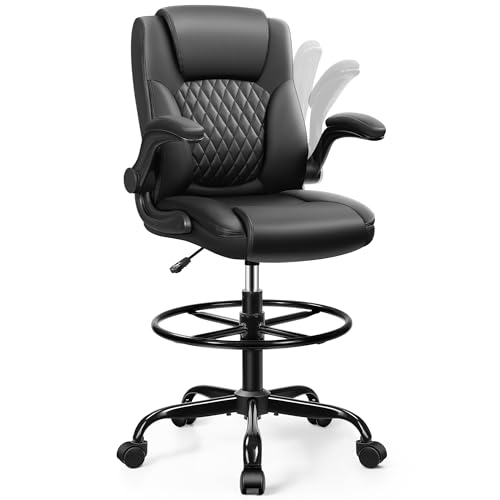
Drafting chairs add a back rest and foot ring to a tall column. Roundups name models such as Primy, SONGMICS, BOLISS, Sweetcrispy and DUMOS, and list height ranges like 24.8 to 32.1 inches for the BOLISS. They cost far less than premium chairs, but the sources behind these lists are mostly affiliate-style sites, and quality is uneven. Look for a stated weight rating, a foot ring that sits at a usable height, a wide stable base and a lockable tilt. Our separate drafting stool guide covers this category in more detail.
Fit and compatibility notes
- Know your standing-height elbow level. Stand with elbows at 90 degrees and measure from floor to forearm. A perching seat should put your elbows near that line when you sit, otherwise you will hunch or shrug.
- Match seat height to desk range. A desk that rises to 48 inches needs a taller seat than a desk topping out at 42. Compare the chair’s maximum seat height with where the desk sits at its highest setting.
- Check base clearance. Wide star bases or foot rings can hit desk legs or a crossbar. Measure the open space beneath the frame.
- Floor type. Hard casters suit carpet, soft casters suit hard floors, and a tall chair on casters should have a firm brake or a weighted glide if the surface is slippery.
- Weight rating. Capacities vary widely, from 275 lb for some home chairs to 400 lb or more for commercial seating. Pick a chair with margin above your weight.
Pick X if…
| If you… | Pick | Why |
|---|---|---|
| Sit more than half the day | Steelcase Gesture or Aeron | Full adjustability and long warranties |
| Want a lower-cost full chair | Branch Ergonomic Chair Pro | Reviewers call it the value choice; lower stated capacity |
| Stand most of the day and want to perch | Håg Capisco 8106 with the tall lift | Seat heights up to 810 mm and a foot ring option |
| Have a small space | Branch Saddle Chair | Tucks under the desk |
| Want a rocking, active perch | Vari Active Seat | Wide height range, no back |
| Need a back rest at a raised desk on a tight budget | Drafting chair with foot ring | Tall column with lumbar support |
Alternatives to consider
- Steelcase Series 1: CNN Underscored named it best overall after reviewing 18 chairs, a mid-premium option with simpler controls.
- Herman Miller Embody: reviewers describe it as strong for deep focus and pressure distribution, at premium cost.
- Anti-fatigue mat plus a regular chair: not a seat at all, but many people find a mat extends standing time and reduces the need for a perch.
Care and safety
Tall seats raise the center of gravity, so use the foot ring, keep the base free of cables and never lean back on a chair not designed to recline. Follow the maker’s manual for the gas lift, and stop using any chair whose cylinder sinks or wobbles. If you have joint pain, circulation problems or balance concerns, ask a physician or physiotherapist before adopting a perching posture for long periods.
Frequently Asked Questions
Can I use a normal office chair with a standing desk?
Yes, if you plan to sit at the desk’s lower setting and stand without a seat. The chair only needs to match your sitting height. A regular task chair will not help when the desk is raised, because its seat height does not reach standing-desk level.
Do I need a drafting chair for a standing desk?
Not necessarily. A drafting chair is useful when you want to rest at the raised height, but many people simply lower the desk and use a normal chair. A drafting chair makes most sense if you stand for the majority of the day and want a back rest during breaks.
Is a saddle seat comfortable for a full workday?
Reviewers describe saddle and active seats as better for movement and short rests than for all-day sitting. The Capisco is the exception most often cited, since it has a back and several height options. If you feel numbness or discomfort, switch back to a conventional chair.
How high should the chair go for a standing desk?
Match it to your elbow height at the raised desk setting. Many tall seats list ranges in the mid-20s to low-30s of inches, and the Capisco’s tall lift reaches about 810 mm. Measure your own desk rather than relying on a general figure.
Is a foot ring necessary?
For a tall chair, yes, because your feet will not reach the floor comfortably. A foot ring supports your legs and reduces pressure behind the thighs. Make sure the ring is compatible with the lift you choose, since the Capisco’s FootRing, for example, fits only certain lifts.
Which budget tier makes sense?
If you sit for hours, spend more on a full chair with adjustable lumbar and a long warranty. If you only perch occasionally, a mid-range stool or drafting chair is usually enough. Premium options pay off mainly through warranty length and adjustment range.







Write Your Review
No reviews yet. Be the first to share your experience!