

For sciatica-prone sitting, the chairs reviewers return to most are the Steelcase Leap (adjustable lumbar and a seat that slides) for people who can spend premium money, the Herman Miller Aeron or Steelcase Amia for people who prefer a different seat feel, and the HON Ignition 2.0 or a mid-range mesh chair with adjustable lumbar and seat depth for people on a tighter budget. No chair treats sciatica, so the aim is simply a seat that lets you change position, avoids pressure behind the thighs and supports the lower back.
Our top picks

As an Amazon Associate we earn from qualifying purchases at no extra cost to you.
A note on health before you buy
Sciatica describes pain that runs along the sciatic nerve, and it has several possible causes. A chair cannot diagnose or cure it. If you have numbness, weakness in a leg, pain that is getting worse, or any loss of bladder or bowel control, see a doctor promptly. If your symptoms are ongoing, a physician or physiotherapist can advise on how long to sit, how to set up a workstation and when to move. Everything below describes comfort features that reviewers and makers highlight, not medical benefits.
What features reviewers look for
- Adjustable lumbar support. Several roundups say to look for support you can move up and down and in firmness, rather than a fixed bulge.
- Seat depth adjustment. A common guideline is a gap of two to three fingers between the seat edge and the back of the knee. A seat that is too deep can press on the thighs.
- Waterfall seat edge. A rounded front edge lessens pressure behind the thighs, according to several reviews.
- Backrest recline that locks. Reviews mention a backrest that locks around 100 to 110 degrees, with the ability to shift to other angles during the day.
- Seat firmness. Some people prefer a firmer seat and some a softer one. This is personal; roundups note that a softer chair such as the Steelcase Amia suits people who find a firm seat uncomfortable.
- Movement. Tilt mechanisms and arms that let you change posture encourage movement, which is usually the point.
At a glance: chairs reviewers mention
| Chair | Best for | Key stated details | Limits |
|---|---|---|---|
| Steelcase Leap (V2) | Adjustable lumbar and seat depth | The maker lists LiveBack, adjustable lumbar, 4D arms, four recline stops, and a seat depth of about 401 to 477 mm; a 400 lb capacity | Premium tier |
| Herman Miller Aeron | Breathable mesh, no seat edge pressure | Sizes A, B and C; the maker lists PostureFit SL lumbar and a 12-year warranty | No seat depth slider per one review; premium tier |
| Steelcase Amia | Softer seat feel | Reviewers describe a softer seat than the Leap | Fewer lumbar controls than the Leap |
| HON Ignition 2.0 | Mid-range office use | The maker lists a 300 lb rating; reviewers cite height and depth lumbar and adjustable seat depth | Fewer premium materials |
| Clatina Mellet | Budget | A roundup lists adjustable seat depth and a 350 lb capacity | Lesser-known brand |
| FlexiSpot C7 | Budget to mid-range | Seat slide and self-adaptive lumbar | Shorter warranty than premium chairs |
| Sihoo Doro C300 | Mesh with adaptive lumbar | Waterfall-edge mesh seat and depth adjustment | Mesh may feel firm to some |
The premium group
Steelcase Leap (V2)
Roundups put the Leap at or near the top for back comfort. A seated-ergonomics review says its lumbar adjusts in height with a separate firmness dial, and the maker lists adjustable lumbar and LiveBack, which lets the backrest flex with the spine. Its seat depth range is described as about 3 inches in older brochures and 401 to 477 mm in newer ones. Other listed details include four recline stops with an upright lock, a 400 lb capacity, and a weight of around 47 lb. The warranty is described as a 12-year multi-shift warranty on the mechanism and a lifetime warranty on the frame and shell in one listing. One roundup suggests that buying remanufactured can bring cost down.
Herman Miller Aeron
One roundup rates the Aeron best overall for sciatica-prone sitting, noting that its mesh seat avoids pressure at the seat edge. The Aeron comes in sizes A, B and C, and the maker says the range is intended to fit a wide span of bodies. Because there is no seat-depth slider according to one review, choosing the right size is the main way to tune thigh support. The maker lists a 12-year warranty and its PostureFit SL lumbar adjustment.
Steelcase Amia
The Amia sits a step below the Leap in cost, and reviewers describe a softer seat. If a firm seat bothers you, it is the sort of chair to try. Its lumbar controls are more limited.
Mid-range and budget options
HON Ignition 2.0
One roundup names it the best choice under a mid-range budget, with height and depth adjustable lumbar and adjustable seat depth. The maker lists a 300 lb rating for the standard model, and 450 lb for the Big and Tall version.
Value mesh chairs
Roundups list the Clatina Mellet, FlexiSpot C7 and Sihoo Doro C300 as lower-cost options with seat depth adjustment and adaptive lumbar. Several other mesh chairs, such as the ELABEST X100, offer lumbar that moves up and down, adjusts in depth and rotates, according to one list. These come with shorter warranties, and reviews are often affiliate-based, so treat them as a shortlist rather than a verdict.
Fit and sizing
- Seat depth versus leg length. Shorter users need a shallow seat so that the back rest supports the spine without pressure behind the knees. Taller users need a deeper seat.
- Seat height. Feet should rest flat with knees near hip level. Check the chair’s stated seat height range against your leg length.
- Lumbar position. The support should sit at the curve of your lower back. If you cannot find that spot, the chair is the wrong size or shape for you.
- Armrests. Adjustable arms reduce shoulder strain and let you shift weight out of the seat when needed.
- Weight and size. Check the stated capacity and seat width.
If possible, sit in a candidate chair for a full workday-sized trial, and look for a return window. Many sciatica-prone sitters report that a chair feels fine for ten minutes and uncomfortable at two hours.
Setting up the chair once you have it
Even a well-chosen chair needs adjusting. Reviewers and ergonomics guides commonly suggest this order: set the seat height so your feet rest flat and your knees sit near hip level, then slide the seat so there is a small gap behind the knees, then place the lumbar support at the curve of your lower back, then set the recline tension so the back follows you without pushing, and finally bring the arms to where your shoulders stay relaxed. Revisit the settings after a week, because your sense of what feels right changes as you get used to a new chair. Also build in movement, since reviewers note that the best seat still works better when you stand and walk at regular intervals.
Budget tiers
Budget: Clatina Mellet, FlexiSpot C7, Sihoo Doro C300 and similar mesh chairs. They offer the adjustments but short warranties.
Mid-range: HON Ignition 2.0 and equivalent office-grade chairs.
Premium: Steelcase Leap and Amia, Herman Miller Aeron, often available remanufactured.
Pick X if…
| If you… | Pick | Why |
|---|---|---|
| Want the most lumbar and seat adjustment | Steelcase Leap | Adjustable lumbar, firmness dial and seat slide |
| Dislike pressure at the seat edge and run warm | Herman Miller Aeron | Mesh seat, three sizes |
| Find firm seats uncomfortable | Steelcase Amia | Softer seat feel |
| Need an office-grade chair at mid-range tier | HON Ignition 2.0 | Adjustable lumbar height and depth, seat depth slide |
| Are on a tight budget | Mellet, C7 or Doro C300 | Seat depth and lumbar controls at lower tiers |
Alternatives
- Sit-stand desk: alternating positions is a common recommendation, and a desk that lets you do so reduces time in a single posture.
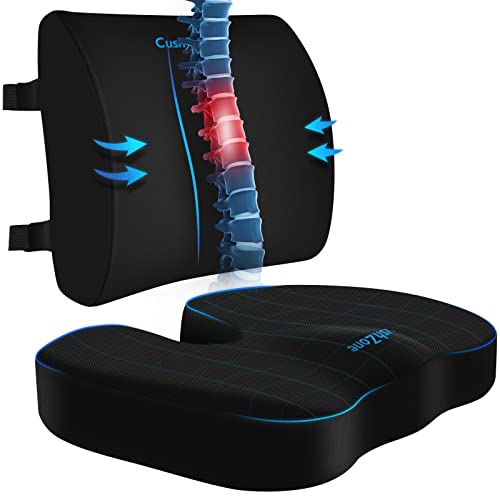
- Add-on lumbar cushion: a portable cushion can adapt a mid-range chair, though it adds another thing to adjust.
- Active seating for short periods: some people use stools or balance seats briefly; ask a clinician if this is appropriate for you.
Frequently Asked Questions
Can an office chair cure sciatica?
No. A chair can make sitting more comfortable, but sciatica has several possible causes that need assessment by a doctor or physiotherapist. Use any chair as one part of a broader plan that includes movement breaks.
What seat depth is best?
Reviewers suggest leaving about two to three fingers of space between the seat edge and the back of your knee. A slider lets you fine-tune this, as the Leap does. Without a slider, choose a size that fits your legs.
Is mesh or cushion better?
It depends on your preference. Mesh avoids hard pressure at the seat edge and stays cool. Some people prefer a softer padded seat. Try both if you can.
How long should I sit at a time?
A clinician can give guidance for your situation. Many general ergonomic suggestions involve changing position often and standing or walking at regular intervals.
Is a premium chair worth it for sciatica-prone sitting?
Premium chairs offer more adjustment and longer warranties, which helps tune the fit. A well-fitted mid-range chair can also work. The fit matters more than the price.
When should I stop using a chair?
Stop if it causes new numbness, tingling or increasing pain, or if the cylinder or mechanism fails. Follow the manual, and seek medical advice for ongoing or worsening symptoms.








Write Your Review
No reviews yet. Be the first to share your experience!