

Key takeaways
- Height: Standard gas cylinders suit most users from roughly average height to somewhat above. Very short users may find the seat too high even at its lowest setting, and a footrest can help.
- Seat width: Wider seats help larger frames and people who sit with legs crossed, but they push the arms farther apart, which can make desk reach awkward.
- Desk clearance: Arms that cannot slide under the desk edge stop you from sitting close. Flip-up or height-adjustable arms solve this.
- Floors: Standard casters suit carpet and low-pile floors. For hard floors, many buyers swap in rubber-coated casters because hard plastic wheels can scratch.
- Assembly: Most arrive in one box and take a modest amount of time. Keep the cylinder and base seated firmly, since a poorly seated cylinder is a common source of squeaks.
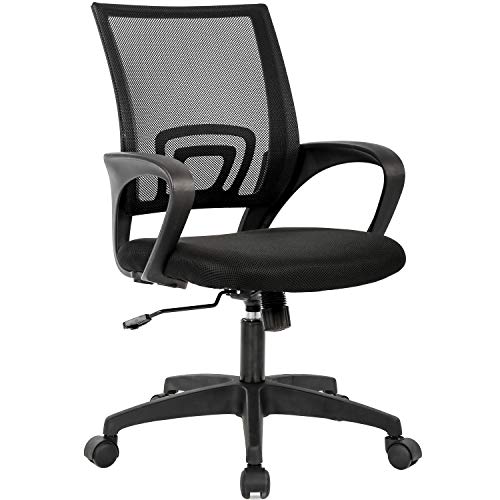
For most people on a tight budget, a mesh chair with adjustable lumbar support and arms that move in more than one direction, such as the Sihoo Doro C300 or Sihoo M57, is the safest starting point, while buyers who only need a chair for a few hours a day can get by with a basic model like the Alera Elusion or Hbada task chair. Heavier users should look first at chairs whose makers list a higher weight rating, and anyone sitting eight hours daily should consider stretching into the mid-range, where seat depth and tilt controls start to appear. The sections below explain what budget mesh chairs actually deliver, where they cut corners, and how to match a chair to your body and desk.
Our top picks



As an Amazon Associate we earn from qualifying purchases at no extra cost to you.
At a glance: budget mesh chairs compared
| Chair | Best for | Key stated features | Limits reviewers mention |
|---|---|---|---|
| Alera Elusion mesh multifunction | Shoppers who want a reliable entry-level pick | Full mesh back, multifunction tilt; named best budget pick by CNN Underscored | Limited armrest angle and backrest height adjustment |
| Sihoo Doro C300 | All-day home office use at a mid-budget level | 4D armrests (height, width, depth, pivot), self-adaptive lumbar, 330 lb capacity per one reviewer | Mesh not regarded as durable as premium Herman Miller mesh |
| Sihoo M57 | Lower-cost chair with a supportive back | Praised as a budget pick by several outlets | Outlets disagree on whether lumbar support is adjustable, so read the maker listing |
| Branch Ergonomic Chair | Buyers who want a longer warranty and a clean look | Adjustable arms, seat depth, lumbar support; 3D arms per Stand Desk Lab | Sits at the top of the budget range |
| Boulies OP300 | Comfort-first shoppers | Tom’s Guide cites comfort as its strength | Fixed lumbar support |
| Hbada office task chair | Starter chair for light use | Mesh back, basic adjustments | Entry-level feature set |
| TRALT mesh chair | Big and tall shoppers on a very low budget | BIFMA certification and 330 lb rating according to roundup writers | Basic hardware, limited fine adjustment |
| NEO CHAIR | Light use, small rooms | Compact budget mesh design | Roughly 275 lb capacity and minimal lumbar adjustment per one reviewer |
Specs change between production runs, so treat this table as a shortlist. The maker’s own listing is the authority on weight rating, dimensions and warranty length.
What budget mesh actually gives you
Mesh backs became popular because they let air pass through, which helps if you run warm or work in a room without strong cooling. A well-tensioned mesh also distributes pressure across the back without the pooling of heat that foam can cause. At the budget level, though, the mesh itself is usually thinner and the frame behind it is plastic rather than metal. Reviewers who rank chairs, including CNN Underscored, note that many chairs in the lowest price bracket feel noticeably less solid than better-built competitors, and that the difference shows up in the base, casters and tilt mechanism more than in the mesh.
Expect a trade-off between breathability and cushioning. Mesh seats feel firm and cool, but some people find them less forgiving over long sessions than a padded seat. If you prefer a softer feel, look for a chair with a mesh back and a foam-padded seat, which is how many budget models are built. Mesh seats tend to suit people who value airflow above softness.
The features that matter most at a low price
Lumbar support
Lower-back support is the feature buyers most often want and budget chairs most often get wrong. Some models, such as the Boulies OP300 according to Tom’s Guide, have fixed lumbar support built into the back shape. That works if the curve happens to match your spine and does not if it does not. Chairs with adjustable or self-adapting lumbar, like the Sihoo Doro C300 as described by Stand Desk Lab, let you shift support up, down or in and out. Where outlets disagree about a model, as they do for the Sihoo M57, assume the more cautious description until the maker’s page confirms otherwise.
Armrests
Armrest adjustment is where budget and mid-range chairs diverge most clearly. Stand Desk Lab explains the numbering: 2D arms adjust in height only, 4D arms add pivot angle and depth or width, and 8D arms offer finer steps within those same axes. Their view is that 4D is the level that matters for most people, because it lets the pad meet your elbow at the actual keyboard position. Several budget chairs advertise adjustable arms, yet reviewers point out that genuine multi-axis movement under a mid-range price is uncommon. The Alera Elusion, for example, is described by CNN Underscored as limited in armrest angle.
Seat depth and tilt
A seat that slides forward and back keeps the edge from pressing into the back of your knees. This feature is rare on the cheapest chairs and more common from the mid-budget tier upward. Tilt controls matter too: a basic tilt with a lock position is common, while a tilt tension knob lets lighter and heavier users adjust the resistance. If you are tall, look for a backrest that is tall enough to reach your shoulder blades; CNN Underscored noted limited backrest height adjustment on the Alera Elusion.
Weight rating and certification
Check the maker’s stated weight capacity and whether the gas cylinder carries BIFMA certification, which relates to safety and durability testing for the cylinder. Roundups mention BIFMA for the TRALT and Furmax chairs. Capacity ratings among budget mesh chairs commonly fall between about 250 and 330 lb, with a few listing more, and one reviewer cites roughly 275 lb for the NEO CHAIR. If you are near the upper limit of any rating, move up a tier or choose a chair built for heavier users; a rating is a ceiling, not a comfort guarantee.
Budget tiers explained
Entry level
The lowest tier covers chairs such as the NEO CHAIR and basic task chairs. They suit light daily use, a student desk, or a guest room. Expect fixed or minimal lumbar, simple arms and a plastic base. These chairs are fine for a couple of hours at a time but are the most likely to show wear on casters and arm pads first.
Upper budget
This tier includes the Alera Elusion, Hbada, TRALT, Boulies OP300 and Sihoo M57. Here you usually find a more convincing back shape, some adjustable parts, and a gas cylinder with a stated certification. Roundups from outlets such as Tom’s Guide and CNN Underscored tend to cluster their budget recommendations in this group.
Stretch budget
The Sihoo Doro C300 and Branch Ergonomic Chair sit at the high end of what most people would call budget. They add multi-axis arms, better lumbar systems or a longer warranty. If you work at a desk most of the day, reviewers consistently suggest this tier gives the best value, since the cost per year of use falls quickly when a chair lasts longer.
Fit and size notes
- Height: Standard gas cylinders suit most users from roughly average height to somewhat above. Very short users may find the seat too high even at its lowest setting, and a footrest can help.
- Seat width: Wider seats help larger frames and people who sit with legs crossed, but they push the arms farther apart, which can make desk reach awkward.
- Desk clearance: Arms that cannot slide under the desk edge stop you from sitting close. Flip-up or height-adjustable arms solve this.
- Floors: Standard casters suit carpet and low-pile floors. For hard floors, many buyers swap in rubber-coated casters because hard plastic wheels can scratch.
- Assembly: Most arrive in one box and take a modest amount of time. Keep the cylinder and base seated firmly, since a poorly seated cylinder is a common source of squeaks.
Pick X if… decision table
| Pick this | If your situation is |
|---|---|
| Sihoo Doro C300 | You sit most of the day and want arms that move in several directions |
| Alera Elusion | You want a respected entry-level pick and can live with limited arm and back-height adjustment |
| Branch Ergonomic Chair | You value warranty length and a simple, tidy design |
| Boulies OP300 | You prefer a comfort-oriented feel and your back fits its fixed lumbar curve |
| TRALT | You are a larger user who wants a stated higher capacity on a small budget |
| Hbada or NEO CHAIR | The chair is for light, occasional or secondary use |
Care and longevity
Mesh is easy to maintain. Vacuum it lightly with a soft brush attachment and wipe with a damp cloth and mild soap; avoid harsh solvents and sharp objects, since a snagged mesh tears. Tighten the bolts under the seat and on the arms every few months, because loosening hardware causes most of the wobble people blame on cheap chairs. Do not stand on a swivel chair, and avoid leaning far back on models without a tilt lock. Keep the weight within the maker’s stated limit, and read the warranty length for the cylinder, frame and mesh separately, as they often differ.
Alternatives worth considering
- Mid-range ergonomic chairs: The Steelcase Series 1 and Series 2 appear in roundups as the next step, with 4D arms and long warranties.
- Foam-seat task chairs: If mesh feels too firm, a padded seat with a mesh back can feel gentler over a long day.
- Used or refurbished business chairs: Retired office chairs from established makers often offer better build quality than new budget models, though warranty coverage varies.
Frequently Asked Questions
Are budget mesh chairs good enough for working eight hours a day?
Some are, but reviewers generally point to the upper end of the budget range for full-day use. Look for adjustable lumbar, a seat that tilts with a lock, and arms that adjust beyond height. If you feel discomfort that persists, talk with a doctor or physical therapist rather than relying on a chair alone.
Does mesh make you sweat less than a padded chair?
Mesh allows more airflow than dense foam, so many people feel cooler. Individual comfort varies, and a firm mesh seat can feel less cushioned. Choosing between mesh and foam is partly a matter of personal preference.
How much weight can a budget mesh chair hold?
Ratings in roundups run from about 275 lb for lighter models to around 330 lb for sturdier ones, and some chairs list more. Always use the maker’s published rating for your chosen model, and stay comfortably below it.
What does BIFMA certification mean on a chair?
BIFMA is an industry standard for office furniture safety and durability, and makers sometimes apply it to components like the gas cylinder. It does not guarantee comfort, and it may cover only part of the chair. Read the listing to see which part is certified.
Do 4D armrests really matter?
Stand Desk Lab argues that 4D arms are the level that matters for most users, because they let the pad meet your elbow at the keyboard. If you use a laptop or a fixed-height desk, even simpler arms may be enough. If you type or use a mouse for hours, extra adjustment is worth seeking.
Why do reviewers disagree about the same chair?
Makers update models, and listings sometimes mix versions with different features, as with the Sihoo M57 lumbar description. Different reviewers also have different bodies and desks. When two outlets disagree, rely on the maker’s current specification page and your own measurements.






Write Your Review
No reviews yet. Be the first to share your experience!