

Key takeaways
- Key specs: LiveBack flexing backrest, adjustable lumbar height and depth on the standard configuration, seat depth slider, four-way adjustable arms, and a standard weight rating in the range of 400 lb according to Steelcase’s published specification sheet for the Leap.
- Who it is for: Anyone sitting five or more hours a day who wants the chair to be the last one they buy for a decade.
- Pros: Genuine leather that ages well, deep adjustability, long manufacturer warranty, and parts that can be replaced.
- Cons: Premium cost, a sporty look that some buyers find less traditional than a tufted executive chair, and leather that runs warm in humid rooms.
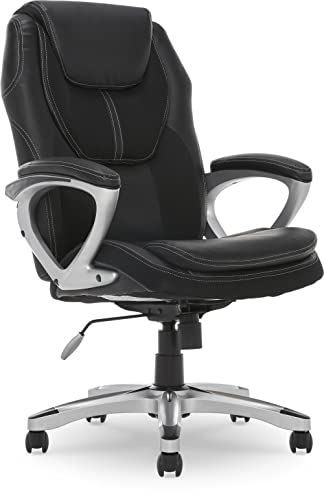
The best executive leather chair for a home office is the one whose leather type matches how many hours you sit: genuine or top-grain leather for full-day use, bonded leather only for light use, and a high-back frame with real lumbar support whichever you choose. For most people working from home, a La-Z-Boy Bellamy or a Steelcase Leap with leather upholstery gives the longest usable life, while Serta and Boss Office Products models cover the mid-range and budget end with bonded or blended leather.
Our top picks


As an Amazon Associate we earn from qualifying purchases at no extra cost to you.
Quick Comparison of the Seven Picks
| Pick | Best for | Upholstery | Typical weight rating | Price tier |
|---|---|---|---|---|
| Steelcase Leap (leather option) | Full-day ergonomics | Genuine leather | Around 400 lb on the standard model | Premium |
| La-Z-Boy Bellamy | Most home offices | Bonded leather with foam padding | Around 275 to 300 lb | Mid-range |
| La-Z-Boy Big and Tall Executive | Larger frames, plush seat | Bonded leather, wood arms | 350 lb | Mid-range |
| Serta Fairbanks | Padded comfort on a budget | Bonded leather | 350 lb | Mid-range |
| Serta Bryce | Warm rooms, light use | Perforated bonded leather with mesh | 250 to 275 lb (listings differ) | Budget |
| Boss Office Products Townsend | Traditional look, small spend | LeatherPlus (bonded blend) | Around 250 lb | Budget |
| COLAMY High Back Executive | Adjustable lumbar and flip-up arms | Genuine leather on selected versions | Around 300 lb | Budget to mid-range |
Weight ratings come from manufacturer and retailer listings and vary by version and year, so confirm the rating for the exact configuration you order. The price tiers are general market positions, not quotes.
Steelcase Leap with Leather: Best Overall for Long Days
The Steelcase Leap is the chair that office-furniture dealers recommend when the buyer asks for an executive look without giving up ergonomics. It is available with genuine leather upholstery, and that is the reason it leads this list: real leather develops a patina instead of peeling, and the Leap’s mechanism is built around a back that flexes with the spine rather than a rigid block of foam.
- Key specs: LiveBack flexing backrest, adjustable lumbar height and depth on the standard configuration, seat depth slider, four-way adjustable arms, and a standard weight rating in the range of 400 lb according to Steelcase’s published specification sheet for the Leap.
- Who it is for: Anyone sitting five or more hours a day who wants the chair to be the last one they buy for a decade.
- Pros: Genuine leather that ages well, deep adjustability, long manufacturer warranty, and parts that can be replaced.
- Cons: Premium cost, a sporty look that some buyers find less traditional than a tufted executive chair, and leather that runs warm in humid rooms.
La-Z-Boy Bellamy: Best for Most Home Offices
The La-Z-Boy Bellamy is a high-back executive chair with a thick, contoured seat and a padded headrest that reads as a lounge chair at a desk. Review roundups regularly name it the best pick for most people because it balances comfort, price and an appearance that suits a study or a living-room corner desk.
- Key specs: High back with integrated headrest, layered foam padding, bonded leather upholstery, tilt with tension control, pneumatic height adjustment, and a weight rating around 275 to 300 lb depending on the listing.
- Who it is for: Remote workers sitting three to six hours a day who care about plushness and style.
- Pros: Generous padding, easy assembly, convincing look at video-call distance.
- Cons: Fixed armrests on most versions and bonded leather that will eventually show wear on the seat edge.
La-Z-Boy Big and Tall Executive Chair: Best for Larger Frames
The La-Z-Boy Big and Tall Executive Chair is built for users who find ordinary executive chairs narrow. Review sites list a 350 lb rating, memory-foam padding and real wood arm accents, which sets it apart from all-plastic competitors.
- Key specs: 350 lb capacity, memory-foam seat cushioning, wood-finish arm caps, height and tilt adjustment, bonded leather cover.
- Who it is for: Taller or heavier users who need a wider seat and a stronger base, and who want a traditional boardroom style.
- Pros: Higher weight rating, plush cushion, durable-feeling base.
- Cons: Limited color choice, no flip-up arms, and a large footprint that needs about 30 inches of clear space on each side.
Serta Fairbanks: Best Padded Comfort for the Money
The Serta Fairbanks uses Serta’s SmartLayers foam, a multi-layer cushion meant to resist flattening, and it carries a 350 lb rating. Listings describe a seat height range of roughly 17.5 to 21.5 inches, padded arms and a tilt lock.
- Key specs: 350 lb capacity, bonded leather, seat height about 17.5 to 21.5 inches, tilt with lock, padded fixed arms.
- Who it is for: Budget-minded buyers who want a thick seat and a higher weight rating than most chairs in this class.
- Pros: Good support for heavier users, comfortable out of the box.
- Cons: Bonded leather can crack at seams within a few years of daily use, and the arms do not adjust.
Serta Bryce: Best for Warm Rooms and Light Use
The Serta Bryce combines perforated bonded leather with mesh side panels and Serta’s patented AIR lumbar support, an inflatable cushion you adjust with a hand pump. The mesh and perforations are what make it the better pick when the room runs warm.
- Key specs: AIR lumbar support, perforated bonded leather with mesh surrounds, layered foam, height adjustment, and a rating listed between 250 and 275 lb.
- Who it is for: Part-time home-office users and students who want an executive silhouette that breathes.
- Pros: More breathable than a solid-leather seat, adjustable lumbar feel.
- Cons: Fixed arms, seams that can split after months of heavy daily use according to several reviewers, and foam that compresses over time.
Boss Office Products Townsend: Best Traditional Look on a Small Budget
The Boss Office Products Townsend High Back Chair is a classic executive design with a pewter-finish base, padded arms and LeatherPlus upholstery, which is a bonded blend marketed as more durable than basic bonded leather. Listings describe a pneumatic lift that spans about 19.5 to 22 inches and a width near 27 inches.
- Key specs: LeatherPlus cover, pewter finish, padded fixed arms, pneumatic seat-height lift of about 19.5 to 22 inches, tilt tension control.
- Who it is for: Light users who want a conservative executive look at the lowest tier.
- Pros: Traditional styling, straightforward adjustments, easy to find replacement casters.
- Cons: Modest lumbar contour and a weight rating that suits average builds only.
COLAMY High Back Executive Chair: Best Adjustability for the Price
The COLAMY executive chair appears on several leather-chair roundups for its adjustable inflatable lumbar support, flip-up armrests and a synchro tilt mechanism, features normally found a tier higher. Some versions use genuine leather over a nylon base, which keeps the price in check.
- Key specs: Inflatable lumbar support, flip-up arms, synchro tilt, high back with headrest, rating around 300 lb in listings.
- Who it is for: Small-desk users who want to tuck the arms under the desk and want some lumbar control.
- Pros: Flip-up arms, adjustable lumbar, genuine-leather versions available.
- Cons: Nylon base is less rigid than metal, the headrest is basic, and color choices are limited. Check which upholstery your exact listing uses.
Leather Types Explained
Most disappointment with executive chairs comes from not knowing what “leather” means on the label. The table below separates the common types.
| Type | What it is | Typical lifespan with daily use | Breathability | Main weakness |
|---|---|---|---|---|
| Top-grain leather | Outer layer of the hide, lightly sanded | 10 to 15 years | Moderate | Needs conditioning |
| Genuine (split) leather | Lower layers of the hide, usually coated | 5 to 8 years | Moderate | Coating can wear at the seat edge |
| Bonded leather | Leather fibre bound with polyurethane onto fabric | 2 to 4 years | Low | Surface peels or flakes |
| PU (faux) leather | Polyurethane over fabric, no leather | 1 to 3 years | Low | Cracks and peels |
The lifespan ranges are typical figures reported by furniture retailers and upholsterers, not guarantees. Hours of use, body weight, sunlight and humidity all shift them. The practical point is that bonded leather is a fine choice for a chair that sees two or three hours a day and a poor choice for one that sees eight.
A worked example shows why this matters. A chair used six hours a day, five days a week, accumulates roughly 1,500 hours a year. A bonded cover that lasts three years has therefore seen about 4,500 hours, while a genuine-leather cover rated for eight years has seen 12,000. Spreading the purchase over those hours, the longer-lived chair can cost less per hour of use even when its sticker tier is higher.
How to Choose: Sizing and Fit With Real Numbers
An executive chair fits when your feet rest flat, your knees sit at roughly 90 degrees, and your elbows meet the desk at the same angle. Use these measurements before ordering.
- Seat height: Measure from the floor to the back of your knee while seated. A 5 foot 6 inch user usually needs a seat height around 16.5 to 19 inches, while a 6 foot 2 inch user needs about 19 to 22 inches. Compare to the listed range.
- Seat depth: Leave two to four fingers (about 2 to 3 inches) between the seat edge and the back of the knee. Executive chairs with fixed seats often run 19 to 21 inches deep, which suits users over about 5 foot 8 inches.
- Weight rating: Choose a rating at least 50 lb above your weight. A 220 lb user comfortably fits a 275 lb chair, while a 280 lb user should look at 350 lb or higher.
- Desk clearance: Standard desks sit about 29 to 30 inches high. Add chair arm height (usually 25 to 28 inches from the floor) and confirm the arms clear the underside, or choose flip-up arms.
- Floor space: A five-star base is typically 26 to 28 inches across. Give it a 36-inch circle to swivel.
Decision Matrix by Situation
| Your situation | Hours per day | Best choice | Why |
|---|---|---|---|
| Full-time remote worker | 6 to 9 | Steelcase Leap with leather | Genuine leather and adjustable mechanism |
| Hybrid worker, video calls | 3 to 6 | La-Z-Boy Bellamy | Looks the part, padded headrest |
| Larger frame | 4 to 8 | La-Z-Boy Big and Tall Executive or Serta Fairbanks | 350 lb ratings |
| Warm room | 2 to 4 | Serta Bryce | Perforations and mesh |
| Small desk | 2 to 5 | COLAMY | Flip-up arms |
| Occasional study chair | 1 to 2 | Boss Townsend | Lowest tier, classic look |
Set Up the Chair in Five Steps
Even a good chair feels wrong if it is set up badly, and most users never touch the levers after assembly. This sequence takes about five minutes.
- Set the seat height first. Sit all the way back, lower the seat until both feet are flat and your thighs are level or slightly sloping down. Height drives every other setting.
- Slide or select seat depth. Where a slider exists (the Leap has one), leave about three fingers behind the knee. On fixed-seat chairs, use a firm back cushion to move your hips forward if the seat is too deep.
- Place the lumbar support. The pad should meet the inward curve of the lower back, roughly at belt level. On inflatable systems such as Serta’s AIR, pump until you feel contact without being pushed forward.
- Adjust tilt tension. You should be able to recline with a light push of the back. If the chair snaps you upright, loosen the tension knob; if it drops you backward, tighten it.
- Finish with the arms. Your shoulders should drop naturally and the forearms should rest level with the desk. If arms do not adjust, flip them up or remove them from the equation by choosing a lower desk height.
Warranty and Purchase Checks
Warranty terms are the clearest quality signal in this category. Premium commercial chairs like the Steelcase Leap carry multi-year warranties that cover the mechanism and the frame, while consumer-oriented executive chairs commonly cover one to five years, often with limited coverage for upholstery wear. Read whether the cover, the foam and the gas lift are included, because the cover is the part that fails first. Also check the return window, ask whether replacement casters and gas lifts are sold separately, and look at the shipping weight: executive chairs often weigh 45 to 70 lb boxed, so plan for a second person to carry the carton.
Ownership Realities: What Wears First
Understanding the failure points saves money. On a leather executive chair the order of wear is usually the same.
- Seat front edge and armrest tops: These take friction and body oils. Bonded leather flakes here first, often after 18 to 30 months of daily use.
- Gas lift cylinder: Lower-cost cylinders can sink after two to four years. Look for a Class 3 or Class 4 cylinder rating, which is a common safety standard for gas lifts.
- Casters: Hard plastic casters scratch wood floors. Replacing them with soft polyurethane casters costs little and takes five minutes.
- Foam: Cheap foam compresses; a seat that has lost 20 to 30 percent of its height is nearing the end of its life.
Care and Maintenance Steps
- Dust weekly with a dry microfiber cloth, because grit acts like sandpaper on the finish.
- Wipe monthly with a cloth dampened with water and a drop of mild soap, then dry immediately.
- Condition genuine or top-grain leather every three to six months with a leather conditioner made for upholstery. Skip conditioner on bonded and PU covers, where it can make the surface tacky.
- Keep the chair at least 2 feet from heaters and out of direct sunlight, which dries and fades leather.
- Tighten the bolts under the seat and the armrest screws once a year.
Common Mistakes to Avoid
- Buying on photographs alone and ignoring the upholstery line in the specification list.
- Choosing a chair at the very edge of its weight rating, which accelerates wear on the base and gas lift.
- Ignoring seat depth, which causes more discomfort for shorter users than the leather itself.
- Skipping a chair mat on carpet, which strains the casters and the base.
- Reclining fully on a tilt mechanism not designed for it, which loads the pivot beyond its design and shortens the life of the mechanism.
Frequently Asked Questions
Is genuine leather better than bonded leather for a home office chair?
Yes for heavy daily use. Genuine leather is made from the hide and ages by developing a patina, while bonded leather has a polyurethane surface that eventually peels. If you sit fewer than three hours a day, bonded leather is a reasonable economy choice.
How long should an executive leather chair last?
A well-made genuine-leather chair with a quality mechanism can last eight to twelve years. Bonded and PU chairs more often last two to four years under daily use, depending on weight and care.
Are leather chairs hot to sit in?
Solid leather and faux leather trap heat. Perforated seats, mesh side panels and a room kept below about 74 degrees Fahrenheit help, and a breathable seat cover is a cheap fix.
Can an executive leather chair be ergonomic?
It can, if it has adjustable seat height, a tilt mechanism with tension control, and lumbar support that fits your lower back. Models such as the Steelcase Leap pair leather with a full ergonomic mechanism, while many decorative executive chairs have fixed lumbar pads only.
What weight rating do I need?
Pick a rating at least 50 lb above your body weight. For users above 250 lb, choose a 350 lb or higher chair with a metal base.
Can I repair peeling leather?
Minor flaking can be hidden with a leather repair kit, but peeling bonded leather rarely holds a repair for long. Professional re-upholstery is possible on solid chairs, but it often costs close to the price of a mid-range replacement.
Write Your Review
No reviews yet. Be the first to share your experience!